Le magazine et marché mondial pour les passionnés de voitures classiques, par des passionnés.
Le magazine et marché mondial pour les passionnés de voitures classiques, par des passionnés.


Filter
Faites votre choix:
- Voir les voitures
-
Marque >>
-
Année >>
-
-
Catégorie >>
- Voir les motos
- Voir les pièces et plus
-
Marque de la voiture >>
-
Constructeur >>
-
Catégorie >>
- Vélos
-
Année >>
-
Pays


Le Mystère de la Voiture Sport Inconnue: Une Enigme à Transmission Par Courroie


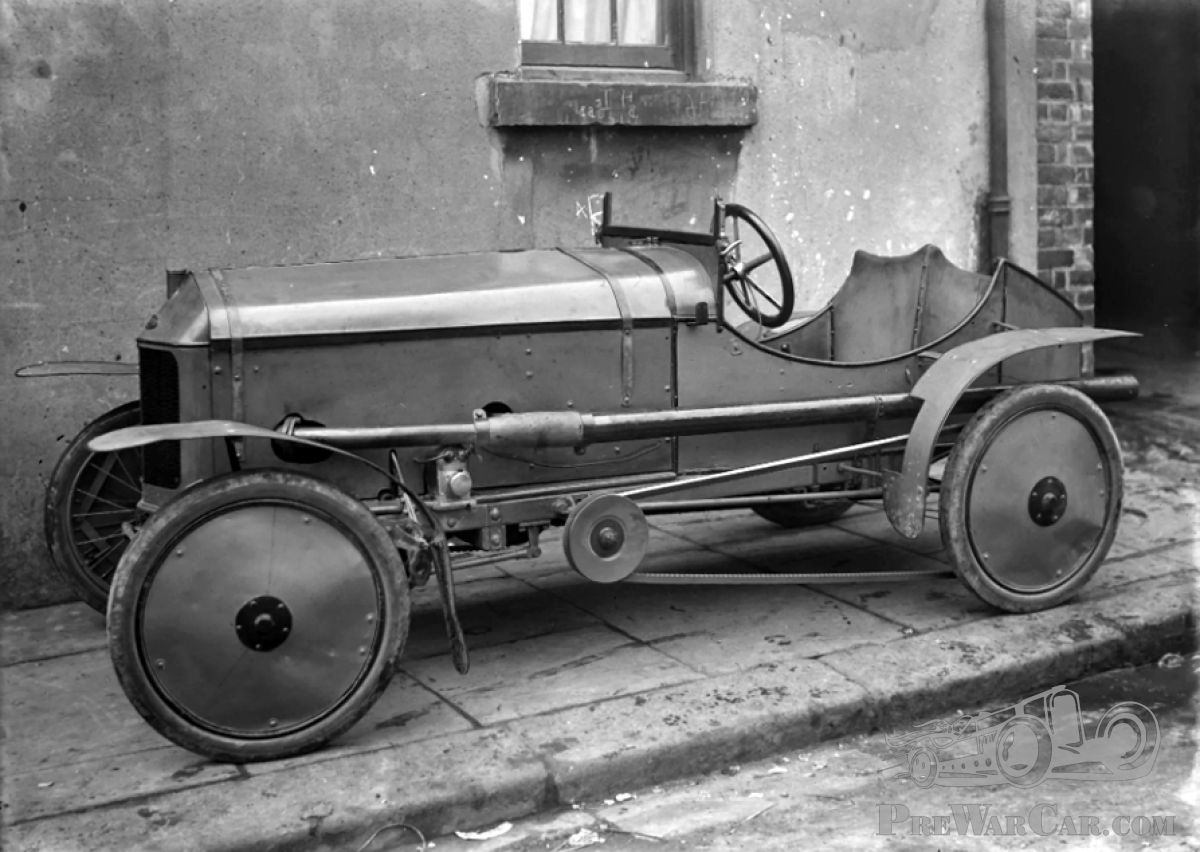


Heureusement, les quatre photos que nous avons sont de très bonne qualité, car en dehors de cela, il nous manque des indices pour résoudre le mystère de cette... enfin, qu’est-ce que c’est exactement ? Ces images proviennent des archives Sankey et montrent une intrigante voiture de sport à deux places dont l’origine reste inconnue.
Les archives elles-mêmes ne peuvent pas nous éclairer sur le passé de cette voiture rare. La seule description disponible indique : « Grand véhicule sportif à une place sur un trottoir. La voiture est propulsée par une courroie et possède des roues massives. » Ce que nous pouvons confirmer, c’est que cette voiture présente des caractéristiques assez inhabituelles. La longue courroie qui entraîne une grande poulie pour les roues arrière est une vraie curiosité, et il y a des courroies des deux côtés du véhicule. Les roues, qui semblent massives, sont en réalité des roues à rayons subtilement dissimulées derrière des jantes plates, offrant un look élégant.
Cependant ce n’est pas un modèle à une seule place, comme on pourrait le croire au premier abord. Une place pour le « mécanicien » est clairement visible, positionnée un peu plus à l’arrière, car une carrosserie aussi étroite ne permettrait pas de sièges côte à côte. La voiture possède également une queue pointue en métal plat et un tableau de bord très minimaliste, avec seulement un compteur sous la colonne de direction. Le système d'échappement est équipé de deux sorties.
Mais quel moteur pourrait se cacher sous ce véhicule mystérieux ? Il y a un indice qui pourrait nous éclairer : « Enregistrement Barrow EO 1065 ». Barrow-in-Furness, cette ville portuaire du comté historique de Lancashire, pourrait bien être la clé pour résoudre cette énigme.
Nous avons le sentiment que cet indice pourrait être décisif. À suivre...
Mots : Jeroen Booij
Image : Archives Sankey
Publié:
lundi décembre 16th, 2024
Facebook
LinkedIn
Twitter
WhatsApp
Email
Copy
Commentaires



Ariejan Bos
18 Décembre 2024, 16:30
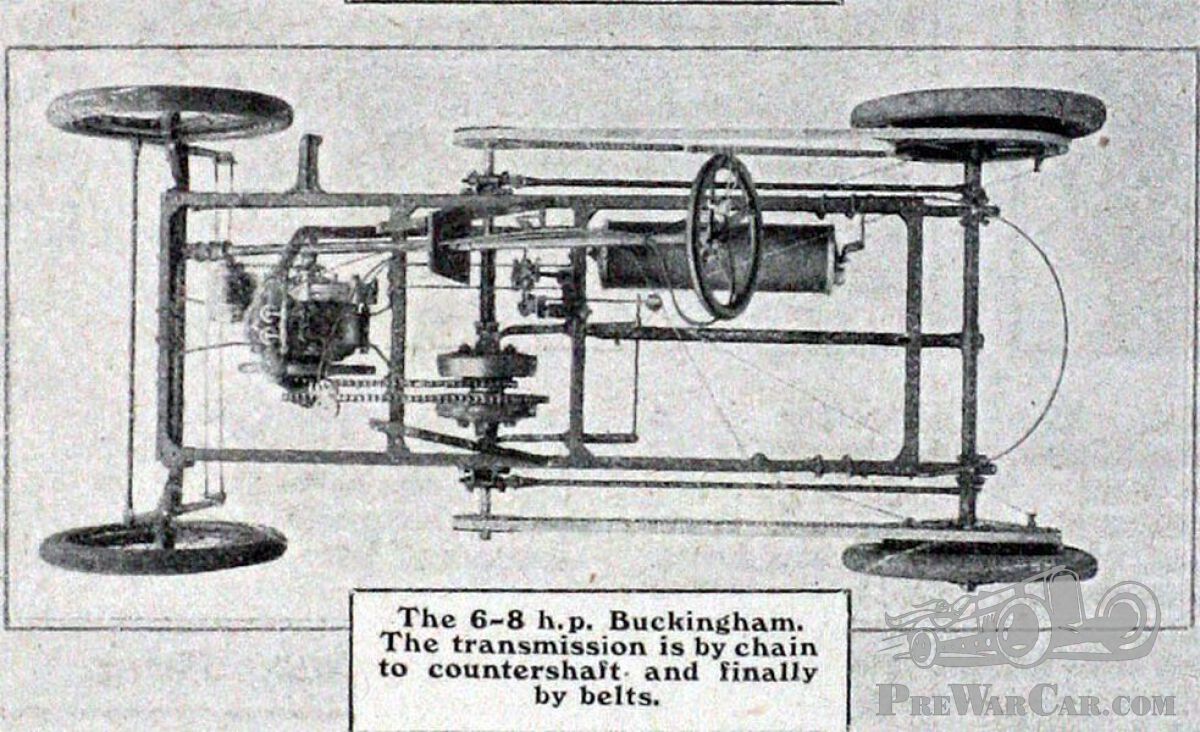
A Buckingham seems to be a good match. The accompanying photos seem to confirm this. The large transmission chain wheel between engine and gearbox is clearly visible below the frame on one of the photos. The late Michael Worthington-Williams published a five-page story on the make in The Automobile of January, 2005, with lots of pictures. However there is no sign of a Buckingham car with this lengthy bonnet combined with the double exhaust. So was this car an official product or a later modification?
Lire la suite
Ariejan Bos
18 Décembre 2024, 18:24
No gearbox, of course, I meant the belt drive...
Lire la suite
David Grimstead
17 Décembre 2024, 22:39
John A. Kent’s friend’s suggestion of a Buckingham seems like a good bet: they offered in 1913-14 a Sporting 12 h.p. Model with a special polished alloy body. That unsilenced large-bore exhaust looks like a racing-car feature. Among the dozens of series-produced cyclecars, few, if any, had the combination of features this one has, notably a water-cooled twin with twin belt drives, transverse front springing, racing body option, disc-over wire wheels, etc. The oval badge looks right too.
According to contemporary records in 1914, J. F. Buckingham of Coventry were making a water-cooled 90-degree vee-twin cyclecar with a two-chain, cone clutch-controlled two speed primary drive to a cross-shaft with twin belt final drives acting as the differential. Transmission was the same for the 89 by 120 m.m., 746 c.c. single cylinder air- and water-cooled versions—reverse was an extra. His in-house built, fore and aft-mounted, vee-twin had slightly offset cylinders of 89 by 88 m.m., giving 1,095 c.c. Just over-square, he claimed it was safe up to 5,000 r.p.m. but a too-tight turn on tarmac could throw off a drive belt.
Coincidental to the registration address, the Barrow Herald reported on the Westmorland Hill Climb at Greyhound Hill between Kendal and Sedbergh on April 18th, 1914: “Cycle-cars were a feature, the 12-h.p. Buckingham with racing body making fastest time in the big event.” It would be pushing coincidence too far to say that the older chap in the car has a moustache like J. F. Buckingham had…
But in May, 1914, J. F. Buckingham himself, drove his “hefty” belt-drive car in the Lancashire Automobile Club’s hill climb at Waddington Fells. He had a runaway win, climbing the hill at very high speed and appearing to be enjoying himself… as he did at many other such events, including at Brooklands.
Lire la suite
According to contemporary records in 1914, J. F. Buckingham of Coventry were making a water-cooled 90-degree vee-twin cyclecar with a two-chain, cone clutch-controlled two speed primary drive to a cross-shaft with twin belt final drives acting as the differential. Transmission was the same for the 89 by 120 m.m., 746 c.c. single cylinder air- and water-cooled versions—reverse was an extra. His in-house built, fore and aft-mounted, vee-twin had slightly offset cylinders of 89 by 88 m.m., giving 1,095 c.c. Just over-square, he claimed it was safe up to 5,000 r.p.m. but a too-tight turn on tarmac could throw off a drive belt.
Coincidental to the registration address, the Barrow Herald reported on the Westmorland Hill Climb at Greyhound Hill between Kendal and Sedbergh on April 18th, 1914: “Cycle-cars were a feature, the 12-h.p. Buckingham with racing body making fastest time in the big event.” It would be pushing coincidence too far to say that the older chap in the car has a moustache like J. F. Buckingham had…
But in May, 1914, J. F. Buckingham himself, drove his “hefty” belt-drive car in the Lancashire Automobile Club’s hill climb at Waddington Fells. He had a runaway win, climbing the hill at very high speed and appearing to be enjoying himself… as he did at many other such events, including at Brooklands.
David Scott
17 Décembre 2024, 07:31
It seems likely to me that the engine is, in fact, a flat-twin mounted fore and aft à la Douglas. The wheel discs are clearly not wood as they are distorted and bent in places, suggesting thin metal. Could the two pulleys be a simple two-speed transmission like a GN or Frazer-Nash? There doesn't seem to be a vast difference in pulley sizes although the belt seems to sit lower in one pulley than the other; maybe the distance between the flanges can be changed by screwing one side in and out at the centre, rather like a Zenith-Gradua? It looks like a modern vee-belt rather than the more common flat belt of most cyclecars, and there's scant sign of any tensioner.
Lire la suite
Tim Hewitt
16 Décembre 2024, 23:13
What a fantastic home-built machine! It raises the question of who was the inspiration, and who was the builder?
The young gent in the background of the first picture obviously finds it amusing, but is the young man in the car the builder, apprentice or driver? Perhaps the more mature gent in the second picture is the instigator of the project, clearly in the belief that he has created "the fastest cyclecar ever." Looking closer at the evidence of the running gear, there seems to be a chain visible under the chassis, and the two exhaust ports would appear to be way too far apart for a vee-twin. I would think that it's maybe two singles linked together, but that does raise the question of the twin-spark magneto which is clearly visible. An engineer who decides to piggy-back two engines is probably more than capable of timing them through a single mag, but why not just use the single mags of each engine and then just worry about making both engines work together?
And why the double belt-drive? Early motorcycle engines didn't have a clutch, so perhaps then, as often now, a clamping pulley, or pulleys, have been introduced to provide a "clutch" system? Picture four also shows that the rear axle is clearly just a beam, so the double belts would provide a differential affect to the drive system. Why is there an access hatch in the right-hand side of the tail?
Clearly they are spoked wheels with beaded-edge (clincher) tyres, as seen in pictures two and four, with fairly crude metal, or possibly thin plywood, outer wheel discs. The rear body could also be thin plywood.
Lastly, if it is built for speed, why have a drag-inducing full-width vertical windscreen?
I'm probably raising more questions than answers, but that's why we all find these pictures fascinating. I'm looking forward to reading any updates.
Lire la suite
The young gent in the background of the first picture obviously finds it amusing, but is the young man in the car the builder, apprentice or driver? Perhaps the more mature gent in the second picture is the instigator of the project, clearly in the belief that he has created "the fastest cyclecar ever." Looking closer at the evidence of the running gear, there seems to be a chain visible under the chassis, and the two exhaust ports would appear to be way too far apart for a vee-twin. I would think that it's maybe two singles linked together, but that does raise the question of the twin-spark magneto which is clearly visible. An engineer who decides to piggy-back two engines is probably more than capable of timing them through a single mag, but why not just use the single mags of each engine and then just worry about making both engines work together?
And why the double belt-drive? Early motorcycle engines didn't have a clutch, so perhaps then, as often now, a clamping pulley, or pulleys, have been introduced to provide a "clutch" system? Picture four also shows that the rear axle is clearly just a beam, so the double belts would provide a differential affect to the drive system. Why is there an access hatch in the right-hand side of the tail?
Clearly they are spoked wheels with beaded-edge (clincher) tyres, as seen in pictures two and four, with fairly crude metal, or possibly thin plywood, outer wheel discs. The rear body could also be thin plywood.
Lastly, if it is built for speed, why have a drag-inducing full-width vertical windscreen?
I'm probably raising more questions than answers, but that's why we all find these pictures fascinating. I'm looking forward to reading any updates.
John A. Kent
16 Décembre 2024, 22:20
According to a friend who is an expert on cyclecars, he says it is a Buckingham, circa 1914. The body is not typical and the fitment of a twin cylinder engine is also unusual.
Lire la suite
Keith Kuehn
16 Décembre 2024, 19:50
I have no idea what make it is, but it's more than likely a one-off. What I do know is, I'd love to have it!
Lire la suite
Robert Mager MacWhirter
23 Décembre 2024, 10:19
Keith Kuehn, it's a very long queue. Get in line!
Lire la suite
David Liepelt
16 Décembre 2024, 16:06
Clearly it has a vee-twin engine by the exhaust pipes. The make of the engine should be hinted at by the placement of the magneto coming through the bonnet side below.
Keep up the great work folks!
Lire la suite
Keep up the great work folks!