Le magazine et marché mondial pour les passionnés de voitures classiques, par des passionnés.
Le magazine et marché mondial pour les passionnés de voitures classiques, par des passionnés.


Filter
Faites votre choix:
- Voir les voitures
-
Marque >>
-
Année >>
-
-
Catégorie >>
- Voir les motos
- Voir les pièces et plus
-
Marque de la voiture >>
-
Constructeur >>
-
Catégorie >>
- Vélos
-
Année >>
-
Pays



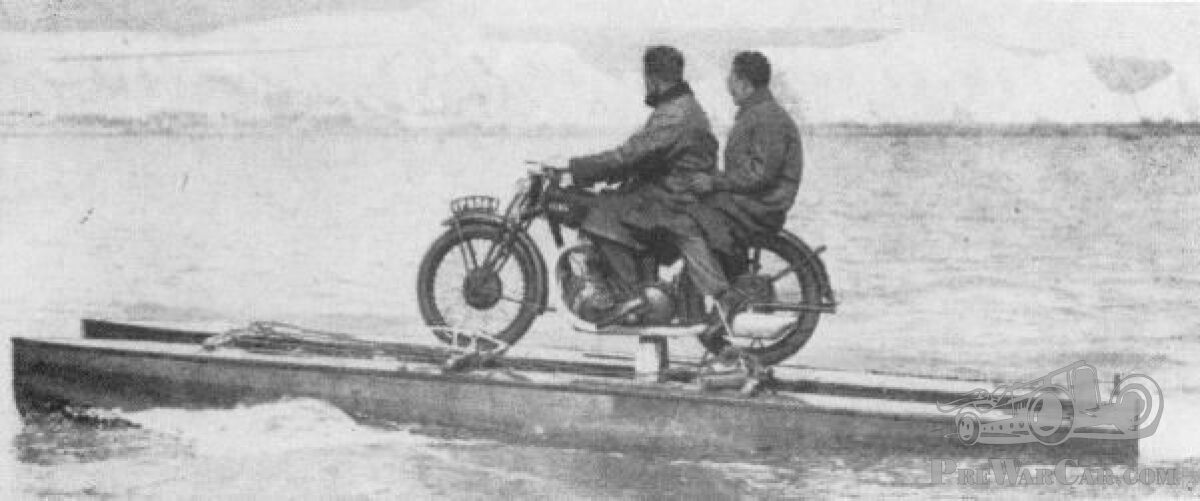
A motorcycle drives this homemade catamaran
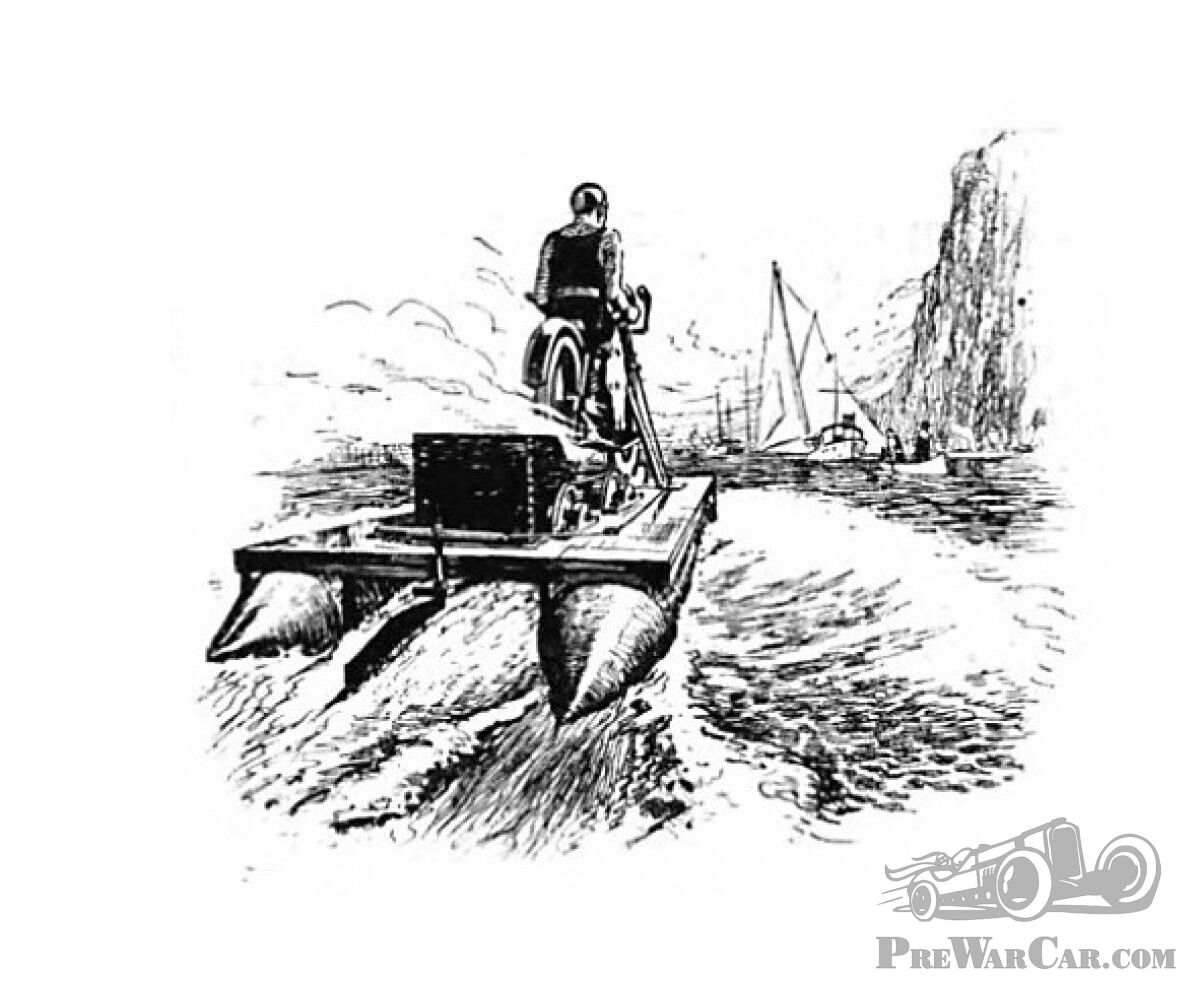



Today we have another DIY project for you. When we found this fun article in the magazine Popular Science Monthly from May 1922 written by P. P. Avery, we thought let`s try and build this catamaran! You can also give it a try if you have nothing planned this weekend. If you do, please send us some photographs of the end result! We very much looking forward receiving them!
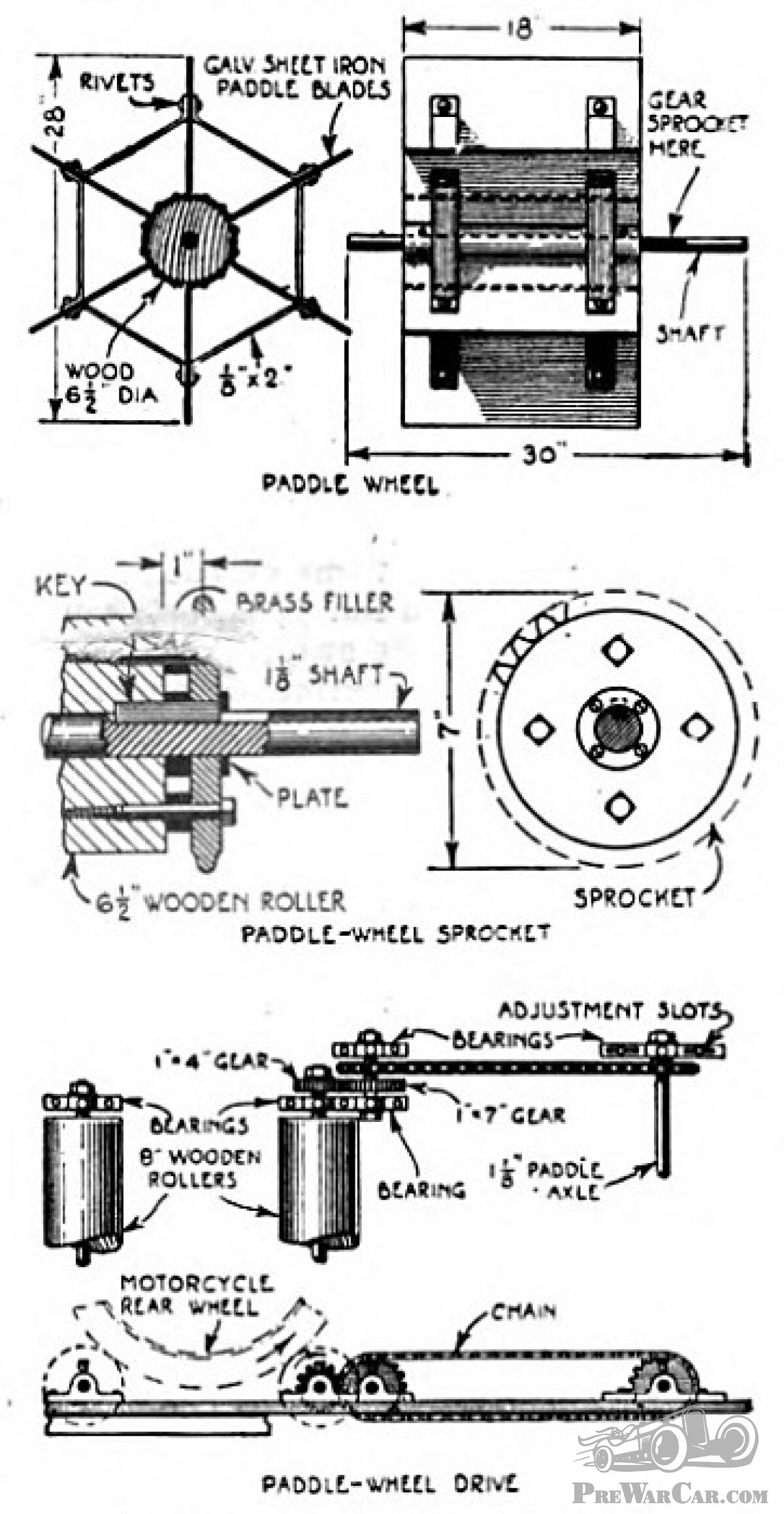
"Any standard motorcycle will serve as the power plant for this novel catamaran of speed raft. The rear wheel of the motorcycle drives an 8-in. wooden roller by friction. This, in turn, drives either a small paddle wheel or a propeller, whichever the builder prefers.
The boat is supported by two cylindrical pontons 14 in. in diameter. They are merely kitchen boilers of either galvanized iron or copper. The nose for each is made of the same material shaped down to a point. The air chamber is continuous through each ponton and the construction must, of course, be absolutely airtight. With the full load, the displacement should be such that the waterline is halfway up on the cylinders.
The pontoons are attached to a wooden framework by ½ in. by 3 in. flatirons, as shown. Use 3/8-in. bolts with lock washers top and bottom for fastening the laps around the tanks.
The flooring should be of sound tongue-and-groove stock well nailed on. Upon the strength and rigidity of the platform depends much of the working efficiency and safety of the completed catamaran. The floor is later covered with canvas, tacked on with copper or galvanized iron nails.
The openings in the floor are reinforced by 1 by 1 in. angle irons screwed fast all around. The heavy mountings such as those for the roller shafts should be secured with 3/8 in. bolts through bearing, angle iron, and nuts. The motorcycle should be stripped of parts that are not absolutely essential to its use a powerplant. The front wheel rests in a wooden block and the machine is firmly clamped in place, front and back. The rear wheel rests on the rollers, as shown, and the rear roller provides the driving power for either the paddle-wheel or propeller. Gears and a chain are used for driving the paddle-wheel and bevel gears and countershaft for the propeller.
All exposed metal parts should be painted with iron paint and the wood-work given two coats of the best spar varnish. These details are all clearly shown in the accompanying drawings.
To operate the catamaran, the engine is started by the usual kick-pedal method, the clutch being in neutral. The speeds are advanced as desired and after the motor is in “high” gear. Adjustment is by spark and gas on the handle-bars. The tiller wheel is conveniently located for steering so that the operator will have no difficulty at all in learning to control the catamaran."
Words by the editor. Source: Popular Science Monthly May 1922 (page 75).
Publié:
mercredi novembre 21st, 2018
Facebook
LinkedIn
Twitter
WhatsApp
Email
Copy
Commentaires
A. Baas Van Ittersum
22 Novembre 2018, 10:22
I wonder how many motorcycles ended up at the bottom of lakes as a result of this jolly idea. My experience is that boating is not an activity that sits happy with pennyless tinkering and wild ideas. I know what went with the oil drum and grass mower contraptions of my youth...... swimming diploma required!
Lire la suite
Bob McGrath
21 Novembre 2018, 07:35
Andre Baldet repeated the exercise on a Vespa powered twin float device in the 1960's.
Lire la suite
Brian Walker
21 Novembre 2018, 03:58
Here is one major U.K manufacturer who thought it was such a good idea they crossed the English Channel. ARIEL in the late '20s.
Lire la suite