Le magazine et marché mondial pour les passionnés de voitures classiques, par des passionnés.
Le magazine et marché mondial pour les passionnés de voitures classiques, par des passionnés.


Filter
Faites votre choix:
- Voir les voitures
-
Marque >>
-
Année >>
-
-
Catégorie >>
- Voir les motos
- Voir les pièces et plus
-
Marque de la voiture >>
-
Constructeur >>
-
Catégorie >>
- Vélos
-
Année >>
-
Pays



Arguably the best Aston Martin barnfind in years (engine photos added)
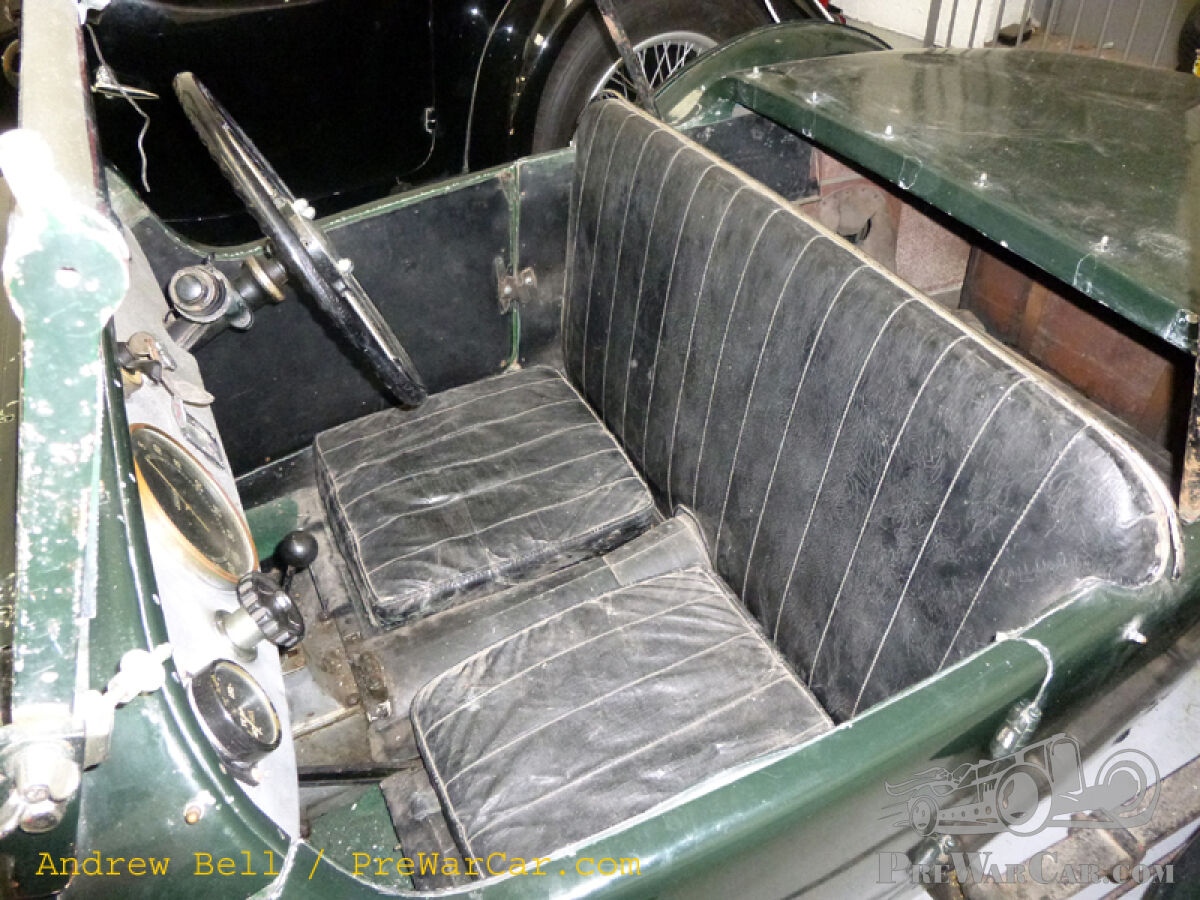





Barnfound DB2s or 4s will pop up with a certain frequency, especially in auction press releases. Yet rarely a more significant, pre-war Aston Martin. We only remember the one presented by Tony Paalman many years ago. Read the exclusive report by pre-war Aston Martin expert Andy Bell who did a truly magnificent find at the south coast by the end of last year: a most original 1929 Sports Model. Arguably the best AM find of this still young millenium:
"I found this 1929 Sports Model purely by chance. This car has been under the radar of the AMOC and the AMHT for over 40 years. I had a small article in a magazine describing how I found a car (another Sports Model) in the USA. A couple of weeks later an old chap phoned me and said that he also had one of them and if I would be interested in buying it. I was, and did! It is possibly the earliest Bertelli Aston which has never been dismantled and rebuilt. Incredibly, it still has its original upholstery and is exactly the same as the original build sheet describes (thanks to the Aston Martin Heritage Trust) right down to its original early cotter type valve gear. I only know one other car running on this type of valve gear and it has all been renewed, so arguably this is the most original engine in existence.
The car has only ever been re-painted. It left the works in 1929 painted sky blue with blue upholstery. All this blue paint is still under the dark green paint which was probably put on in the 1950’s and this is the only thing that has been changed since the car was first sold.
(Editor: would it be possible to strip off the green paint alone, while preserving the sky blue paint below?)
Only six 2 seater ‘Sports Model’s were made. They represent the beginnings of Bertelli’s decision to aim production more towards sports cars than the touring cars (the ‘T-type’), that the early company was set up by Renwick and Bertelli to produce. The original idea (mostly on the insistence of Renwick who was providing the capital to start the Renwick and Bertelli company) was that the new Aston Martin car should be a top quality touring car to rival Rolls Royce. However, Bertelli advised Renwick right from the start that this aim would surely use up all his inherited fortune and so they decided to make the overhead cam engine to sell to car manufacturers, rather like the Blackburn or Meadows engines, so they produced the overhead cam 1 ½ litre engine which was to provide the design for engines right up to 1939.
When Renwick and Bertelli bought the Bamford and Martin Ltd. (who made the side valve Aston Martin), they were then able to make cars and even at this time Renwick was fairly determined to make touring cars. However, after Renwick left the company Bertelli, who had a lot of motor racing experience more or less had a free hand to make his beloved sports cars and this is immediately what he did. The ‘Sports Model’ is therefore the short wheel base (but with underslung chassis) version of the touring ‘T-type’. From 1929 onwards with slight modifications to the chassis and running gear it became the ‘International’ which is the model that put the Bertelli Astons on the map."
Publié:
samedi janvier 4th, 2014
Facebook
LinkedIn
Twitter
WhatsApp
Email
Copy
Commentaires
Inconnu
06 Janvier 2014, 10:32
Inconnu
05 Janvier 2014, 16:38
Dear Sir,
under certain circunstances it may be possible to remove the later paint of this car, but this has to be considered, examined and tested very carefully.
The first thing to consider is: in most cases there has been a cause for re-painting, as an accident or other severe damages in the first paint. So it has to be examined, how much of the original paint is still underneath. If there is only a fragmented rest, it may not be reasonable to remove the later paint.
The same applies, when the surface of the earlier paint has been sanded before applying the later layers, which is common practise.
In an next step it is important to test if the layers can be separated mechanically or chemically without damaging the earlier one. This mainly depends on which materials have been used. In 1929 most likely a nitrocellulose paint will have been used, which is a very vulnerable material. Nitro-layers applied over it tend to „fuse“ very tightly with these materials, because the solvents will „etch“ the older layers. Layers of artificial resin paint will not, but they are very hard to „crack“ without damaging nitro-layers underneath. Thus, a well-defined removal of the later layers without injuring the older paint is complicated. If the circumstances are fortunate, like in the case of an Alvis Speed 20 I had in my workshop last years, it may be possible to separate the paint layers, but these cases are rather rare.
Of course, these are just „remote diagnostics“ based on my experiences with similiar problems on other vehicles. These must be clarified thorougly in every individual case. But please, please don’t try homespun remedies like extensive washing with nitro-dilutend, harsh abrasive treatments or other brutal methods, - this will surely cause much more damage than use! In such cases it will be necessary to formulate a special dilutend mixture for sensitive testing and other than usual workmanship methods!
Altogehter it also has to be considered if the car will not be „restored asunder“ and historically disrupted by the removal of the second paint. As I understood, the car has not been changed since the 1950ies and displays a unique, homogeneous, untouched, historcally evolved condition. If there are (even minour) changes from later periods, which have not been present while the car was displaying the first paint, the „historic entity“ of the vehicle would be disrupted when bringing out the earlier paint. On the other hand, a try to make such details „fit in again“ by changing them to „first paint condition“ may cause severe interventions into the whole substance of the car and maybe large-scale losses of historic substance (the substance, which makes this vehicle so unique).
Gundula Tutt
Conservator-Restorer
Germany
Lire la suite
under certain circunstances it may be possible to remove the later paint of this car, but this has to be considered, examined and tested very carefully.
The first thing to consider is: in most cases there has been a cause for re-painting, as an accident or other severe damages in the first paint. So it has to be examined, how much of the original paint is still underneath. If there is only a fragmented rest, it may not be reasonable to remove the later paint.
The same applies, when the surface of the earlier paint has been sanded before applying the later layers, which is common practise.
In an next step it is important to test if the layers can be separated mechanically or chemically without damaging the earlier one. This mainly depends on which materials have been used. In 1929 most likely a nitrocellulose paint will have been used, which is a very vulnerable material. Nitro-layers applied over it tend to „fuse“ very tightly with these materials, because the solvents will „etch“ the older layers. Layers of artificial resin paint will not, but they are very hard to „crack“ without damaging nitro-layers underneath. Thus, a well-defined removal of the later layers without injuring the older paint is complicated. If the circumstances are fortunate, like in the case of an Alvis Speed 20 I had in my workshop last years, it may be possible to separate the paint layers, but these cases are rather rare.
Of course, these are just „remote diagnostics“ based on my experiences with similiar problems on other vehicles. These must be clarified thorougly in every individual case. But please, please don’t try homespun remedies like extensive washing with nitro-dilutend, harsh abrasive treatments or other brutal methods, - this will surely cause much more damage than use! In such cases it will be necessary to formulate a special dilutend mixture for sensitive testing and other than usual workmanship methods!
Altogehter it also has to be considered if the car will not be „restored asunder“ and historically disrupted by the removal of the second paint. As I understood, the car has not been changed since the 1950ies and displays a unique, homogeneous, untouched, historcally evolved condition. If there are (even minour) changes from later periods, which have not been present while the car was displaying the first paint, the „historic entity“ of the vehicle would be disrupted when bringing out the earlier paint. On the other hand, a try to make such details „fit in again“ by changing them to „first paint condition“ may cause severe interventions into the whole substance of the car and maybe large-scale losses of historic substance (the substance, which makes this vehicle so unique).
Gundula Tutt
Conservator-Restorer
Germany
Lovely find.