Le magazine et marché mondial pour les passionnés de voitures classiques, par des passionnés.
Le magazine et marché mondial pour les passionnés de voitures classiques, par des passionnés.


Filter
Faites votre choix:
- Voir les voitures
-
Marque >>
-
Année >>
-
-
Catégorie >>
- Voir les motos
- Voir les pièces et plus
-
Marque de la voiture >>
-
Constructeur >>
-
Catégorie >>
- Vélos
-
Année >>
-
Pays


Avoir une voiture à Croydon avant la guerre
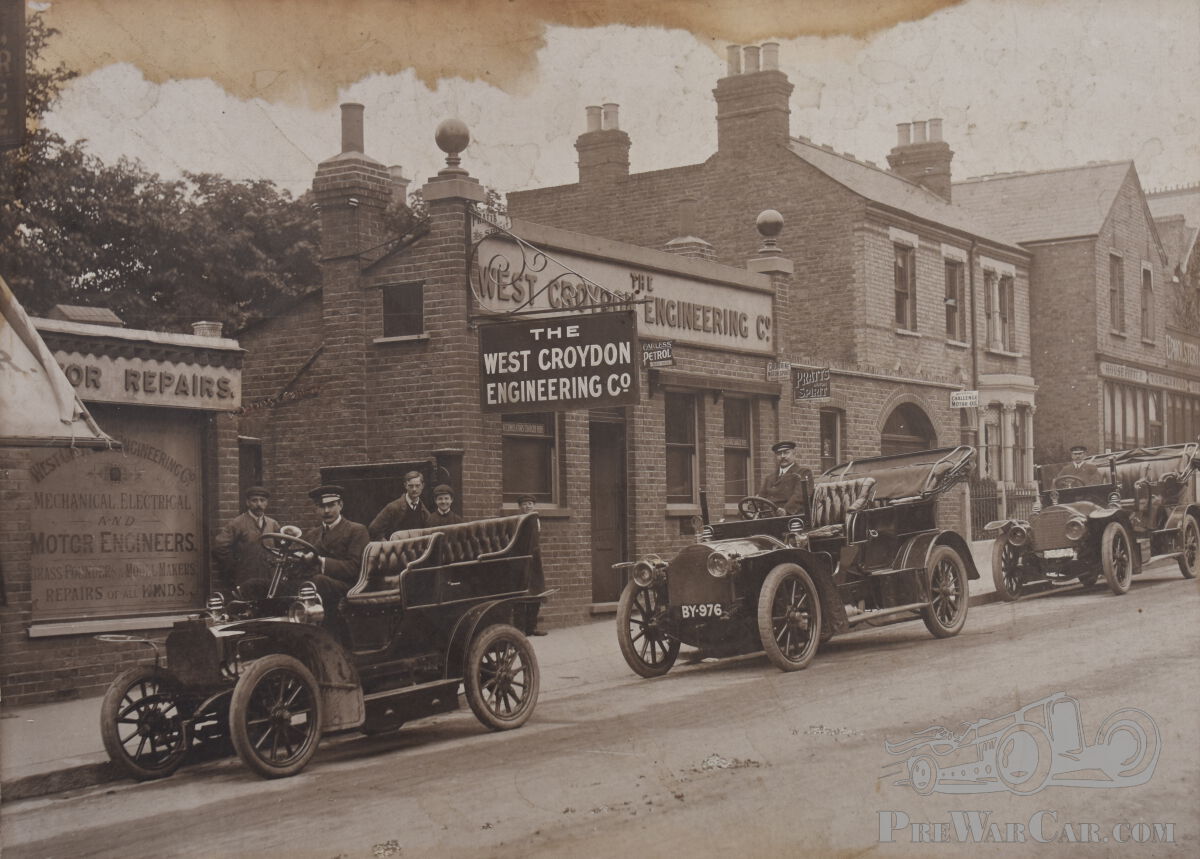

On n'aime pas être méchant, mais il serait juste et exact de dire que le Croydon d'aujourd'hui, une grande ville située juste au-delà des limites de Londres, se caractérise surtout par sa prolifération de gratte-ciel à bottes et de magasins de poulets frits douteux. Il n'en a pas toujours été ainsi. Nos ancêtres victoriens et édouardiens attendaient que la beauté soit présente partout et Croydon a été construit conformément à cette norme.
Par conséquent, nous avons ici une scène des plus attrayantes, avec la West Croydon Engineering Co. qui occupe le devant de la scène. Si vous étiez automobiliste à Croydon sous le règne du roi Édouard, cette entreprise devait être très utile à connaître car elle opérait en tant que "Mechanical, Electrical and Motor Engineers, Brass Founders and Model Makers" (ingénieurs en mécanique, électricité et moteurs, fondeurs de cuivres et modélistes). Elle était située au 4A St. Michael's Road et on sait qu'elle a existé au moins de 1906 à 1910.
À l'arrière, il y avait un atelier d'usinage très bien équipé. Outre l'ingénierie générale, l'entrée de West Croydon Engineering Co. dans le Ward's Croydon Directory mentionnait qu'elle entretenait également des voitures pour la vente ou la location, et nous nous demandons si nous ne sommes pas en train de regarder son parc de voitures de location ici. Toutes les voitures sont impressionnantes, en particulier les plus grandes avec la carrosserie Roi-des-Belges, et chacune a son propre chauffeur élégamment vêtu.
Malheureusement, nous avons du mal à les identifier. La voiture au premier plan n'est pas si difficile à identifier. Il s'agit clairement d'une Peugeot et, avec sa carrosserie de type tourer plutôt que tonneau, elle est probablement légèrement postérieure à l'époque vétérane, de 1906 environ. Les deux autres voitures, en revanche, sont d'une tout autre nature. Aucune voiture britannique ne nous vient immédiatement à l'esprit. S'agirait-il plutôt d'une des prestigieuses marques italiennes ? Nous vous laissons le soin d'y réfléchir.
Par ailleurs, Croydon a développé des liens beaucoup plus étroits avec l'automobile, car un certain nombre de constructeurs automobiles ont vu le jour au cours des années Veteran, Edwardian et Vintage, mais le seul à avoir connu un succès durable a été Trojan, qui a duré jusqu'en 1965, date à laquelle ses seuls produits étaient la Trojan 200 bubble car (une Heinkel construite sous licence) et l'Elva Courier.
Paroles: Zack Stiling; photographie: Collection Stiling
Publié:
mardi juin 6th, 2023
Facebook
LinkedIn
Twitter
WhatsApp
Email
Copy
Commentaires

Henk Brauer
11 Juin 2023, 12:13
Interesting photo, story and question. I hope you will get more information and will go on to develop much stronger ties to the motor-car as Croydon had a number of car manufacturers Veteran, Edwardian and Vintage, plus Trojan and Elva. There's enough information and energy to write articles and organize a Croydon car manufacterers memorial event. We do in the Netherlands a memorial event for the first car in the Netherlands 130 years ago and the first dutch motorist. More information is available on request, or look up Borderline-Oldtimer-Grens/zland.
Lire la suite
David Grimstead
08 Juin 2023, 15:01
A forerunner company at this address first appeared as Hirst’s Steam Cycle Works, St. Michael's Road, West Croydon, in mid-1887 and was most likely started by Arthur William Hirst, who in 1885 ran the Alhambra Bicycle Works in nearby Poplar Walk. He was a cyclist and photographer who made his own equipment.
It remained as a bicycle and tricycle works until advertised from at least 1892 as “Hirst and Co. Ltd., Mechanical Engineers, Brassfounders &c., Steam Works and Offices St. Michael’s-road, West Croydon. Brass and gunmetal castings to customer’s own patterns. Manufacturers of all kinds of photographic equipment”. It had updated its capabilities by 1896 when it was advertised as “Mechanical and Electrical Engineers, Brassfounders, &c. – small power gas engines a speciality.” The company installed the lighting system at Croydon’s new Theatre Royal and Ward’s Photographic Studio in 1899 but went downhill thereafter and after a court case over electric lamps in April 1900, A. W. Hirst’s company was reported bankrupt in July.
It was bought by Messrs. Henry and William Hilton La Motte, the latter an electrical engineer, who perhaps then renamed it West Croydon Engineering Co., which as such in 1901 made an application for a petroleum storage licence for St. Michael’s Road – hence the “Pratt’s Spirit”, “Carless Petrol” and “Moebius Challenge Motor Oil” signs in the photo. “Hirst, Croydon” was retained as its telegraphic address. In 1902 it advertised: “Engines, shafting, pulleys, brackets, etc., supplied and fixed. Repairs of all kinds. Motor car repairs”. Initially, car repairs and rentals seem to have remained a small part of its operation; the company erected the complete plant for Carl Hentschel Colortype Ltd. in West Norwood in January 1902.
During 1906, Messrs. La Motte put the business up for sale and Ernest Strutt of Thornton Heath bought the site’s lease for £300, with a £250 loan from a speculating Purley builder, George Bates. Strutt was its owner/manager from September 1906 but the loan contract was onerously flawed and he ended in court in early 1908 resisting threatened foreclosure. He lost but the business survived.
A new partnership was formed between Strutt and Gerald Howard Gardner for 1908, which advertised that West Croydon Engineering was “The Recognised Motor Works.” Not everyone recognised the quality of the work and that year they had to sue a travelling sales rep for non-payment for repairs to “a very old Panhard.” After operating those Peugeots and Martinis identified by Ariejan, Renault - "quiet, silent, flexible" - was the make of rental car the company offered “for weekends” or “by the day, week or month” during 1909. However, Strutt and Gardner’s partnership as “Motor, Electrical and General Engineers” at West Croydon Engineering Company was dissolved by mutual agreement in November 1910, with the former again keeping the business.
From 1911, Strutt entered a short-term partnership with T. W. Elsdon, who then sold Strutt half his shares and another with Albert Atkinson, which ended in court action. In 1913 Ernest Strutt, now the sole proprietor of West Croydon Engineering Ltd., personally took a repaired car out on test with Mr. Bucher, its dissatisfied owner, at the hazardous time of 11:45 pm on a Saturday in November and collided with a horse-drawn taxicab on Wimbledon Common. The cab company legally sought recompense and a judge concluded Strutt drove carelessly, awarding £30 damages against him and his company; he had to pay his and Bucher’s defence costs too.
Nothing relevant to the St. Michael's Road factory was reported after that but Strutt, still living in Thornton Heath, was fined in spring 1925 for driving at Leatherhead with no front number plate and in summer 1932 escaped prosecution for a collision at Gadbrook Crossroads – in court he said on oath that he was 61, had been driving for 32 years and “I am one of the oldest drivers in the country, with an absolutely clean driving record…”
Finally, an inevitable, sad but apposite post-script: Ernest Strutt, described by his brother as a retired widower motoring expert, died aged 69 in February 1939 after catching what proved to be a lethal chill driving “an old crock” in the very wet November 1938 London-Brighton run...
Lire la suite
It remained as a bicycle and tricycle works until advertised from at least 1892 as “Hirst and Co. Ltd., Mechanical Engineers, Brassfounders &c., Steam Works and Offices St. Michael’s-road, West Croydon. Brass and gunmetal castings to customer’s own patterns. Manufacturers of all kinds of photographic equipment”. It had updated its capabilities by 1896 when it was advertised as “Mechanical and Electrical Engineers, Brassfounders, &c. – small power gas engines a speciality.” The company installed the lighting system at Croydon’s new Theatre Royal and Ward’s Photographic Studio in 1899 but went downhill thereafter and after a court case over electric lamps in April 1900, A. W. Hirst’s company was reported bankrupt in July.
It was bought by Messrs. Henry and William Hilton La Motte, the latter an electrical engineer, who perhaps then renamed it West Croydon Engineering Co., which as such in 1901 made an application for a petroleum storage licence for St. Michael’s Road – hence the “Pratt’s Spirit”, “Carless Petrol” and “Moebius Challenge Motor Oil” signs in the photo. “Hirst, Croydon” was retained as its telegraphic address. In 1902 it advertised: “Engines, shafting, pulleys, brackets, etc., supplied and fixed. Repairs of all kinds. Motor car repairs”. Initially, car repairs and rentals seem to have remained a small part of its operation; the company erected the complete plant for Carl Hentschel Colortype Ltd. in West Norwood in January 1902.
During 1906, Messrs. La Motte put the business up for sale and Ernest Strutt of Thornton Heath bought the site’s lease for £300, with a £250 loan from a speculating Purley builder, George Bates. Strutt was its owner/manager from September 1906 but the loan contract was onerously flawed and he ended in court in early 1908 resisting threatened foreclosure. He lost but the business survived.
A new partnership was formed between Strutt and Gerald Howard Gardner for 1908, which advertised that West Croydon Engineering was “The Recognised Motor Works.” Not everyone recognised the quality of the work and that year they had to sue a travelling sales rep for non-payment for repairs to “a very old Panhard.” After operating those Peugeots and Martinis identified by Ariejan, Renault - "quiet, silent, flexible" - was the make of rental car the company offered “for weekends” or “by the day, week or month” during 1909. However, Strutt and Gardner’s partnership as “Motor, Electrical and General Engineers” at West Croydon Engineering Company was dissolved by mutual agreement in November 1910, with the former again keeping the business.
From 1911, Strutt entered a short-term partnership with T. W. Elsdon, who then sold Strutt half his shares and another with Albert Atkinson, which ended in court action. In 1913 Ernest Strutt, now the sole proprietor of West Croydon Engineering Ltd., personally took a repaired car out on test with Mr. Bucher, its dissatisfied owner, at the hazardous time of 11:45 pm on a Saturday in November and collided with a horse-drawn taxicab on Wimbledon Common. The cab company legally sought recompense and a judge concluded Strutt drove carelessly, awarding £30 damages against him and his company; he had to pay his and Bucher’s defence costs too.
Nothing relevant to the St. Michael's Road factory was reported after that but Strutt, still living in Thornton Heath, was fined in spring 1925 for driving at Leatherhead with no front number plate and in summer 1932 escaped prosecution for a collision at Gadbrook Crossroads – in court he said on oath that he was 61, had been driving for 32 years and “I am one of the oldest drivers in the country, with an absolutely clean driving record…”
Finally, an inevitable, sad but apposite post-script: Ernest Strutt, described by his brother as a retired widower motoring expert, died aged 69 in February 1939 after catching what proved to be a lethal chill driving “an old crock” in the very wet November 1938 London-Brighton run...
Ariejan Bos
06 Juin 2023, 13:42
Interesting photo, which I have seen before. As can easily be observed, the Peugeot lacks chain-drive leaving only a few possibilities: probably it is a 1905 Model 68, a one-cylinder model with Cardan drive. The other two cars are both Martinis from the 1905 to 1907 period. The front car is the older one, ca.1905, and the other one probably 1906-1907.
Lire la suite