Le magazine et marché mondial pour les passionnés de voitures classiques, par des passionnés.
Le magazine et marché mondial pour les passionnés de voitures classiques, par des passionnés.


Filter
Faites votre choix:
- Voir les voitures
-
Marque >>
-
Année >>
-
-
Catégorie >>
- Voir les motos
- Voir les pièces et plus
-
Marque de la voiture >>
-
Constructeur >>
-
Catégorie >>
- Vélos
-
Année >>
-
Pays



Des livraisons rapides et rationalisées à l'ère du jazz


Maintenant que le principe de conception "la forme suit la fonction" nous a laissé des véhicules utilitaires et des voitures particulières aussi excitants qu'une bouteille de lait, il est bon de se remémorer des temps plus joyeux, où le design des véhicules utilitaires pouvait être outrageusement stylisé avec une esthétique aérodynamique palpitante inspirée des voitures de record de vitesse. Cette petite camionnette en est un excellent exemple.
Il s'agit d'un châssis Commer ou Albion, habillé d'une carrosserie assez étonnante réalisée par Holland Coachcraft de Govan, une région de Glasgow en Écosse. Ce véhicule a été utilisé dans les années 1930 par la Universal Laundry Company of Greater Manchester, mais il n'était certainement pas seul. Holland Coachcraft a séduit les blanchisseries et des fourgons similaires ont été utilisés par la Collars Laundry de Londres et la Pioneer Laundry de Liverpool. Une flotte entière a été construite pour Castlebank Dyeworks de Glasgow. Oui, pour une raison ou une autre, les produits du carrossier écossais avaient la faveur des propriétaires de blanchisseries.
Bien que les carrosseries aient été fabriquées en métal sur un cadre en tube d'acier, la moitié inférieure de celle-ci semble être en bois laqué brillant. S'agit-il de bois véritable ou d'un simulacre de peinture, comme sur le tableau de bord de la Facel Vega ? Nous ne serions pas surpris s'il s'agissait d'une peinture complexe, à en juger par les efforts déployés pour donner à ces fourgons une belle apparence. Malheureusement, Holland Coachcraft n'a pas duré très longtemps. Avec l'éclatement de la guerre en 1940, l'entreprise a été mise sous séquestre en 1940. On ne sait pas si l'une de ses belles fourgonnettes Art déco a survécu.
Paroles : Jeroen Booij ; photo : Universal Laundry Services
Publié:
mercredi novembre 15th, 2023
Facebook
LinkedIn
Twitter
WhatsApp
Email
Copy
Commentaires
Andrew Minney
19 Novembre 2023, 10:49
I am currently working on the history of Holland Coachcraft.
Lire la suite
David Grimstead
16 Novembre 2023, 15:12
If you could ask William H. Holland about his design principles, he being more successful as a designer than a manufacturer of vans, he might well say he quite favoured form following function, provided those terms were interpreted his way. Likely he would be offended if you suggested his designs were outrageously styled…
His problem was that commercial chassis suppliers in the 1930s probably couldn’t provide the right underpinnings to make the best of his designs. In 1937, he said that his registered structural designs did not yet incorporate what he called “a scientific chassis layout.” This he defined as: “to put the load of passengers or goods in the centre of the vehicle instead of over the back axle, and to build the streamlined coach work round it, putting the engine in the most suitable place compatible with balance.”
Holland said he started designing streamlined vans as early as 1927 and in mid-1931, set up “an experimental plant in Govan, Glasgow in order to concentrate on the production of coachwork designs which would be marketable nationally.” Early vans seem to have been speculative concepts intended to encourage the establishment of a significant motor body building industry in Glasgow but he licenced his designs for others to build elsewhere. He contracted-out “a series of special coach-body designs” in 1933 to the vehicle works of Messrs. John Stewart and Co. in Wishaw outside Glasgow, “for use in various parts of the country… to show how adaptable these designs are for publicity purposes.”
The streamlined van which was the star of the Olympia Show in November 1933 was built on a Commer Centaur by W. & T. Robson to a design originating at Holland’s 95 Bath Street, Glasgow C2 offices, which were under a mile away from Govan. Another Holland-designed streamlined good’s van on a 2-ton Centaur chassis was shown at the Scottish Motor Show in November 1934. More examples were built by S. H. Bond of Rusholme, Manchester for T. Kerfoot Ltd, of Bardsley (“Vapex Cures Colds” and “Pills from Parkinsons”) 1934-36 on similar chassis. These were ash-framed, with a birch-ply lining, 18-gauge silver-steel body panels and polished aluminium mouldings.
Some of his designs of bread vans for Land and Stevensons, Glasgow, built on Albion chassis in 1934 were distinctly not streamlined. Instead, panel vans incorporating novel features such as quickly interchangeable advertising panels for their sides – using vehicles as mobile advertising hoardings seems to be an element of Holland’s design principles. A streamlined Collars Ltd. laundry van was displayed at the June 1936 Scottish Highland Show; it used a Commer 15cwt forward control chassis and was described as designed and constructed by Holland Coachcraft of Glasgow; construction seems questionable, unless it was just a one-off concept demonstrator, as Holland’s contemporary Castlebanks’ Glasgow open back laundry trucks, with streamlined cabs and tail fairings, were built on Albion chassis by Henry Alexander Ltd. of Edinburgh.
Holland’s joint-stock company, Holland Coachcraft, 95 Bath Street, Glasgow was reregistered in June 1935 with just £3000 share capital. It did not start “production” until Holland opened a 20,000 square foot factory on Princes Way on the new Team Valley Trading Estate in Gateshead-on-Tyne in spring 1937. At the time he was still recruiting sales staff to sell commercial coachwork from his Glasgow office.
A Commercial Motor report of his factory’s imminent start-up said that William Holland had “hitherto, confined his activities to design, and his streamlined bodies for commercial vehicles have been a feature of his activities. He has now decided to enter the field of production, concentrating his attention on the Midland, Northern and Scottish markets.” A North Shields paper said that “the Team Valley factory will be his first venture into production.” He was also quoted there saying that cars were now capable of speeds up to 300mph, yet commercial vehicles barely reached a tenth of that…
His Team Valley factory was the first to open and was recruiting managers, drawing-office staff and skilled craftsmen regularly in Scottish and English papers from 1937 until late 1939. Commercial Motor reported its production methods: “a standardized process without standardizing the finished products. That is to say, the sections are manufactured on a production basis but the actual building of the body is to the individual design of each customer. In the beginning, each body is the subject of a study by technical experts, who determine the stresses and strains before developing the design. The work is distributed to the various specialized production sections, afterwards being closely checked before assembly and finishing.” It was caught up in allegations of bad working conditions generally on the estate but was defended by shop-stewards of the National Union of Vehicle Builders – it paid over the national minimum hourly rate.
Apart from any streamlined vans built, 1937-39, in its final year it also built a dental surgery trailer for Northumberland C.C., a semi-streamlined Bedford fire tender for Gosforth U.D.C. and a body for a Wilson electric van chassis. The bespoke nature of the manufacturing process must have limited demand and made its products unprofitably expensive.
Despite a company being set up in December 1939 to promote all Team Valley products, with William H. Holland a director, a creditor’s meeting for Holland Coachcraft Ltd. was held at the estate’s office in March 1940, followed by his company being voluntarily wound up in April. Its nearly new plant, tools, materials and office equipment was auctioned on 16-17th April 1940. There seems to be no mention of Holland Coachcraft there, Glasgow or Govan after that. Fancy vans were not going to be profitable sellers in wartime – utilitarian would be the order of the day for the next ten years.
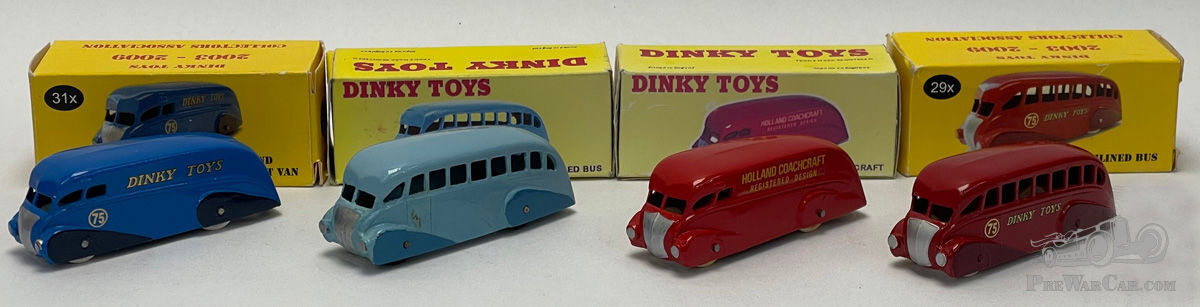
PS: Dinky Toys made four models of his vans in 1935: one each in a different colour for Holland’s children. These were, according to later auctioneers, the rarest Dinky Toys ever made but Dinky then made another 2000 for public sale up to 1936.
Lire la suite
His problem was that commercial chassis suppliers in the 1930s probably couldn’t provide the right underpinnings to make the best of his designs. In 1937, he said that his registered structural designs did not yet incorporate what he called “a scientific chassis layout.” This he defined as: “to put the load of passengers or goods in the centre of the vehicle instead of over the back axle, and to build the streamlined coach work round it, putting the engine in the most suitable place compatible with balance.”
Holland said he started designing streamlined vans as early as 1927 and in mid-1931, set up “an experimental plant in Govan, Glasgow in order to concentrate on the production of coachwork designs which would be marketable nationally.” Early vans seem to have been speculative concepts intended to encourage the establishment of a significant motor body building industry in Glasgow but he licenced his designs for others to build elsewhere. He contracted-out “a series of special coach-body designs” in 1933 to the vehicle works of Messrs. John Stewart and Co. in Wishaw outside Glasgow, “for use in various parts of the country… to show how adaptable these designs are for publicity purposes.”
The streamlined van which was the star of the Olympia Show in November 1933 was built on a Commer Centaur by W. & T. Robson to a design originating at Holland’s 95 Bath Street, Glasgow C2 offices, which were under a mile away from Govan. Another Holland-designed streamlined good’s van on a 2-ton Centaur chassis was shown at the Scottish Motor Show in November 1934. More examples were built by S. H. Bond of Rusholme, Manchester for T. Kerfoot Ltd, of Bardsley (“Vapex Cures Colds” and “Pills from Parkinsons”) 1934-36 on similar chassis. These were ash-framed, with a birch-ply lining, 18-gauge silver-steel body panels and polished aluminium mouldings.
Some of his designs of bread vans for Land and Stevensons, Glasgow, built on Albion chassis in 1934 were distinctly not streamlined. Instead, panel vans incorporating novel features such as quickly interchangeable advertising panels for their sides – using vehicles as mobile advertising hoardings seems to be an element of Holland’s design principles. A streamlined Collars Ltd. laundry van was displayed at the June 1936 Scottish Highland Show; it used a Commer 15cwt forward control chassis and was described as designed and constructed by Holland Coachcraft of Glasgow; construction seems questionable, unless it was just a one-off concept demonstrator, as Holland’s contemporary Castlebanks’ Glasgow open back laundry trucks, with streamlined cabs and tail fairings, were built on Albion chassis by Henry Alexander Ltd. of Edinburgh.
Holland’s joint-stock company, Holland Coachcraft, 95 Bath Street, Glasgow was reregistered in June 1935 with just £3000 share capital. It did not start “production” until Holland opened a 20,000 square foot factory on Princes Way on the new Team Valley Trading Estate in Gateshead-on-Tyne in spring 1937. At the time he was still recruiting sales staff to sell commercial coachwork from his Glasgow office.
A Commercial Motor report of his factory’s imminent start-up said that William Holland had “hitherto, confined his activities to design, and his streamlined bodies for commercial vehicles have been a feature of his activities. He has now decided to enter the field of production, concentrating his attention on the Midland, Northern and Scottish markets.” A North Shields paper said that “the Team Valley factory will be his first venture into production.” He was also quoted there saying that cars were now capable of speeds up to 300mph, yet commercial vehicles barely reached a tenth of that…
His Team Valley factory was the first to open and was recruiting managers, drawing-office staff and skilled craftsmen regularly in Scottish and English papers from 1937 until late 1939. Commercial Motor reported its production methods: “a standardized process without standardizing the finished products. That is to say, the sections are manufactured on a production basis but the actual building of the body is to the individual design of each customer. In the beginning, each body is the subject of a study by technical experts, who determine the stresses and strains before developing the design. The work is distributed to the various specialized production sections, afterwards being closely checked before assembly and finishing.” It was caught up in allegations of bad working conditions generally on the estate but was defended by shop-stewards of the National Union of Vehicle Builders – it paid over the national minimum hourly rate.
Apart from any streamlined vans built, 1937-39, in its final year it also built a dental surgery trailer for Northumberland C.C., a semi-streamlined Bedford fire tender for Gosforth U.D.C. and a body for a Wilson electric van chassis. The bespoke nature of the manufacturing process must have limited demand and made its products unprofitably expensive.
Despite a company being set up in December 1939 to promote all Team Valley products, with William H. Holland a director, a creditor’s meeting for Holland Coachcraft Ltd. was held at the estate’s office in March 1940, followed by his company being voluntarily wound up in April. Its nearly new plant, tools, materials and office equipment was auctioned on 16-17th April 1940. There seems to be no mention of Holland Coachcraft there, Glasgow or Govan after that. Fancy vans were not going to be profitable sellers in wartime – utilitarian would be the order of the day for the next ten years.
PS: Dinky Toys made four models of his vans in 1935: one each in a different colour for Holland’s children. These were, according to later auctioneers, the rarest Dinky Toys ever made but Dinky then made another 2000 for public sale up to 1936.
Mike Costigan
15 Novembre 2023, 09:24
The Dinky Toys Collectors' Association produced a model based on the Hollandcraft van:
Lire la suite
Larry Lewis
15 Novembre 2023, 02:41
Streamliner trucks seemed to be quite the thing in the '20s and '30s.
I think it can be a whole field of interest and wonder if a book has ever been published about them. Also trucks shaped to look like milk bottles or beer bottles and many others.
Lire la suite
I think it can be a whole field of interest and wonder if a book has ever been published about them. Also trucks shaped to look like milk bottles or beer bottles and many others.