Le magazine et marché mondial pour les passionnés de voitures classiques, par des passionnés.
Le magazine et marché mondial pour les passionnés de voitures classiques, par des passionnés.


Filter
Faites votre choix:
- Voir les voitures
-
Marque >>
-
Catégorie >>
- Voir les motos
- Voir les pièces et plus
-
Marque de la voiture >>
-
Constructeur >>
-
Catégorie >>
- Vélos
-
Année >>
-
Pays



Gobron-Brillié à nouveau : la voiture des 100 mph de Rigolly
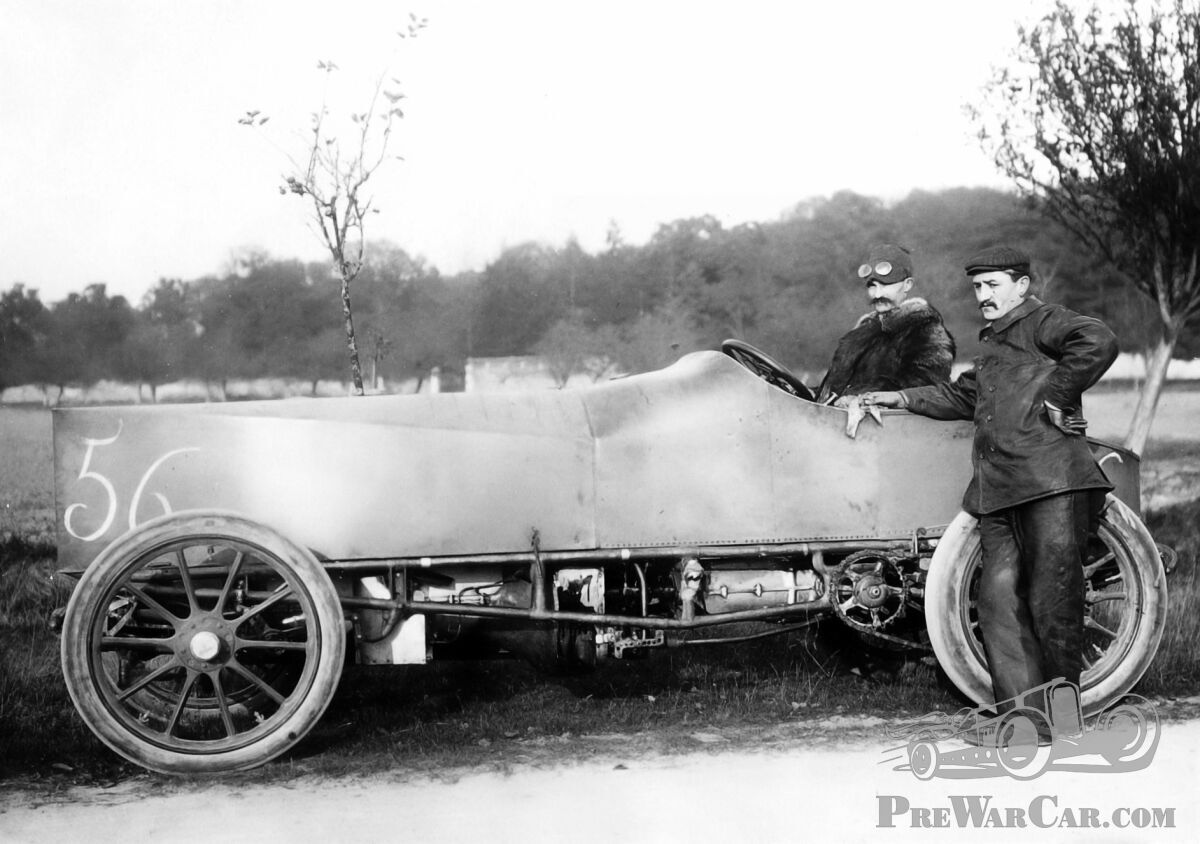

Ces derniers mois, nous vous avons déjà proposé plusieurs articles consacrés à Gobron-Brillié. Le premier est paru en mai, suivi en juin d'un autre article consacré aux voitures de course de la marque. Un mois ayant encore passé, nous avons eu envie de consacrer un nouvel article à ce constructeur français tout à fait hors du commun.
La voiture représentée ici serait la Gobron-Brillié de 100 ch de Louis Rigolly lors de la course de côte de la Côte de Gaillon, disputée le 30 octobre 1904. Elle était équipée du moteur à pistons opposés que nous avons décrit dans nos précédents articles et serait très probablement la même voiture que Rigolly pilota lors de l'Ostend Automobile Week, en Belgique, le 21 juillet 1904. Ce jour-là, il parcourut le kilomètre lancé à la vitesse remarquable de 166,665 km/h, entrant dans l'histoire comme le premier homme à dépasser les 100 mph (160 km/h) au volant d'une automobile.
La Gobron-Brillié de Rigolly aurait reçu une carrosserie allégée montée sur un châssis tubulaire, mais les informations fiables concernant cette voiture semblent étonnamment rares. Peut-être l'un de nos lecteurs en sait-il davantage ? Nous avons toutefois appris que la carrière sportive de Rigolly fut relativement brève. Elle prit fin en 1906, lorsque Gobron-Brillié se retira progressivement des grandes compétitions internationales. Il mena ensuite une vie discrète en France, traversa les deux guerres mondiales et s'éteignit en 1958, à l'âge de 82 ans.
Texte : Jeroen Booij
Photo : source inconnue
Publié:
lundi août 10th, 2026
Facebook
LinkedIn
Twitter
WhatsApp
Email
Copy
Commentaires
Graham Rankin
10 Août, 10:15
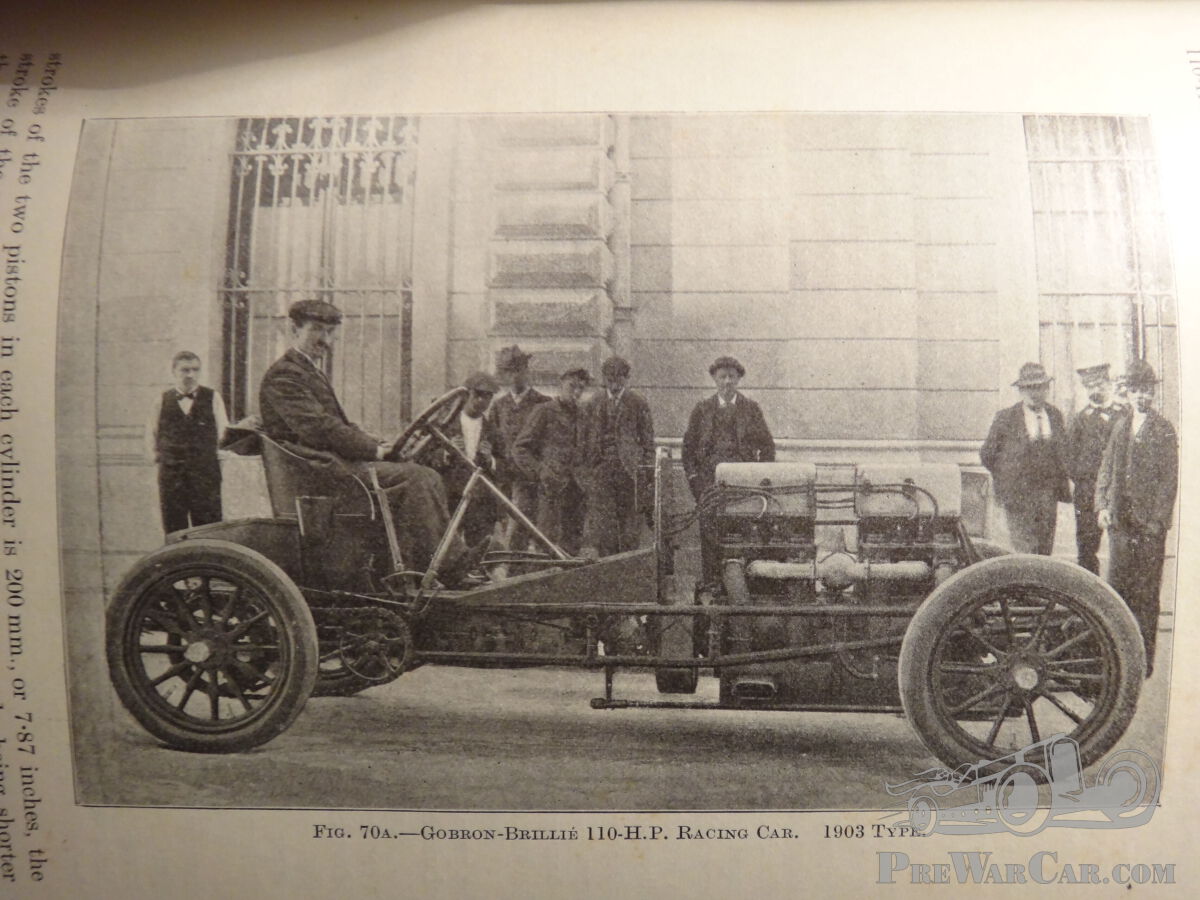
Here is another photo of a 110 HP race car from 1903 which may interest readers and which is extracted from the ever wonderful W. Worby-Beaumont publication---Archibald Constable & Company Ltd, 16 James Street, London--1906. Volume 2. (42 Shillings net).
...."Of the car illustrated, it may be mentioned that the engine is of nominally 110 HP and it has cylinders of 140mm, or 5.51 inches bore. The combined strokes of the two pistons in each cylinder is 200mm, or 7.87 inches, the stroke of the upper pistons, with the long connecting rods, being shorter than that of the lower pistons, and as arranged in the smaller engines. The stroke of the lower pistons is about 1.27 times greater than that of the upper pistons. During 1904 Rigolly drove the racing car of that year's construction at a recorded speed of nearly 95 miles per hour."....
Lire la suite
...."Of the car illustrated, it may be mentioned that the engine is of nominally 110 HP and it has cylinders of 140mm, or 5.51 inches bore. The combined strokes of the two pistons in each cylinder is 200mm, or 7.87 inches, the stroke of the upper pistons, with the long connecting rods, being shorter than that of the lower pistons, and as arranged in the smaller engines. The stroke of the lower pistons is about 1.27 times greater than that of the upper pistons. During 1904 Rigolly drove the racing car of that year's construction at a recorded speed of nearly 95 miles per hour."....
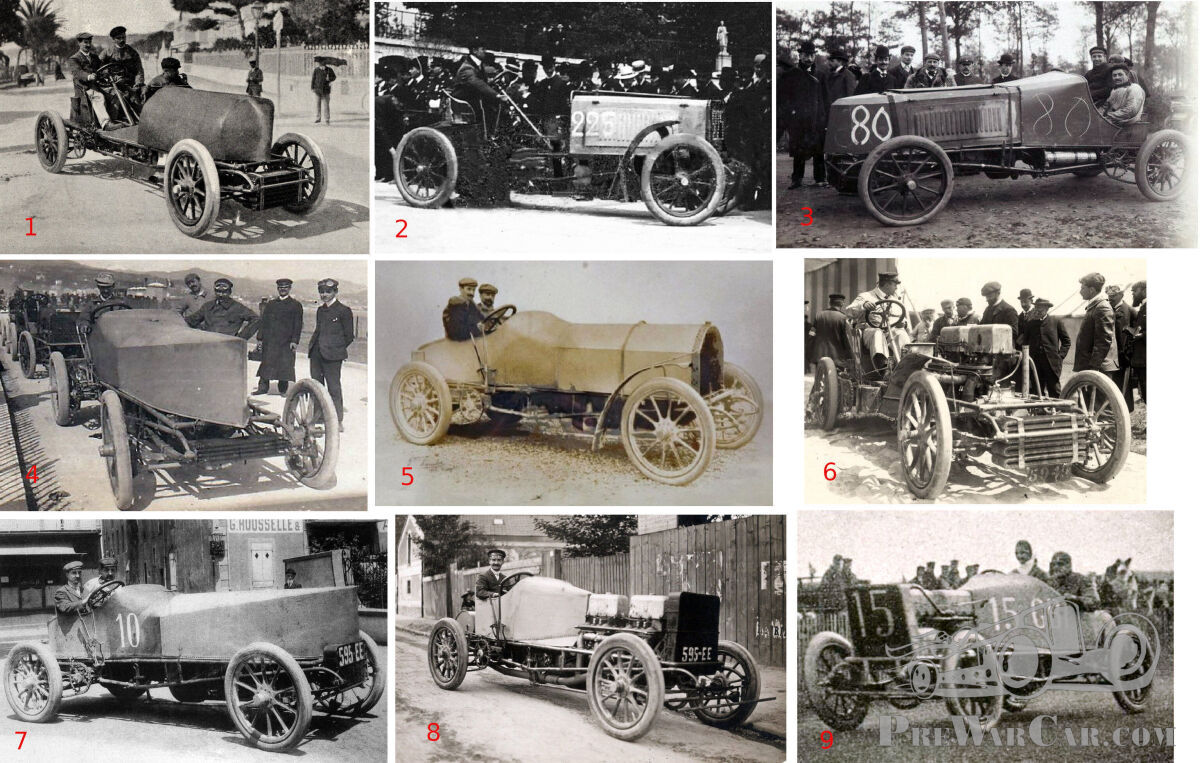
It is remarkable that Gobron-Brillié continued to use this tubular frame till and with the 1907 Grand Prix de l’ACF, when in fact all other makes had already changed to pressed steel frames for years. As I stated before, the car was fast and performed well on relatively short races, but during long distance races, especially during the circuit races with their many turns and braking moments, they either didn’t perform well or were even forced to withdraw by mechanical failure like worn-out tyres or broken radiators. It could well be that a lot of trouble was caused by frame torsion due to the large and powerful engine.
In the uploaded image I’ve collected the different appearances of the car in the 1903-1907 period, showing the first time a change was observed: 1. Semaine de Nice 1903 (Rigolly); 2. Paris-Madrid 1903 (Duray); 3. Kilomètre de Dourdan 1903 (Duray); 4. Semaine de Nice 1904 (Rigolly); 5 and 6. Gordon Bennett trials 1904 (Rigolly resp. Burton); 7. Gordon Bennett trials 1905 (Rigolly); 8. Grand Prix de l’ACF 1906 (Rigolly); 9. Grand Prix de l’ACF 1907 (Rigolly). The 1906 and 1907 Grand Prix cars seem to be more or less identical.
To be continued …?