Le magazine et marché mondial pour les passionnés de voitures classiques, par des passionnés.
Le magazine et marché mondial pour les passionnés de voitures classiques, par des passionnés.


Filter
Faites votre choix:
- Voir les voitures
-
Marque >>
-
Année >>
-
-
Catégorie >>
- Voir les motos
- Voir les pièces et plus
-
Marque de la voiture >>
-
Constructeur >>
-
Catégorie >>
- Vélos
-
Année >>
-
Pays



Introduction de l'automobile en Autriche-Hongrie

Hatschek pictured with his Velo in 1895

The 1893 photograph of Zardetti aboard his 4hp Benz Viktoria

The three-wheeled Patent-Motor-Wagen illustrated in the 1893 Benz catalogue
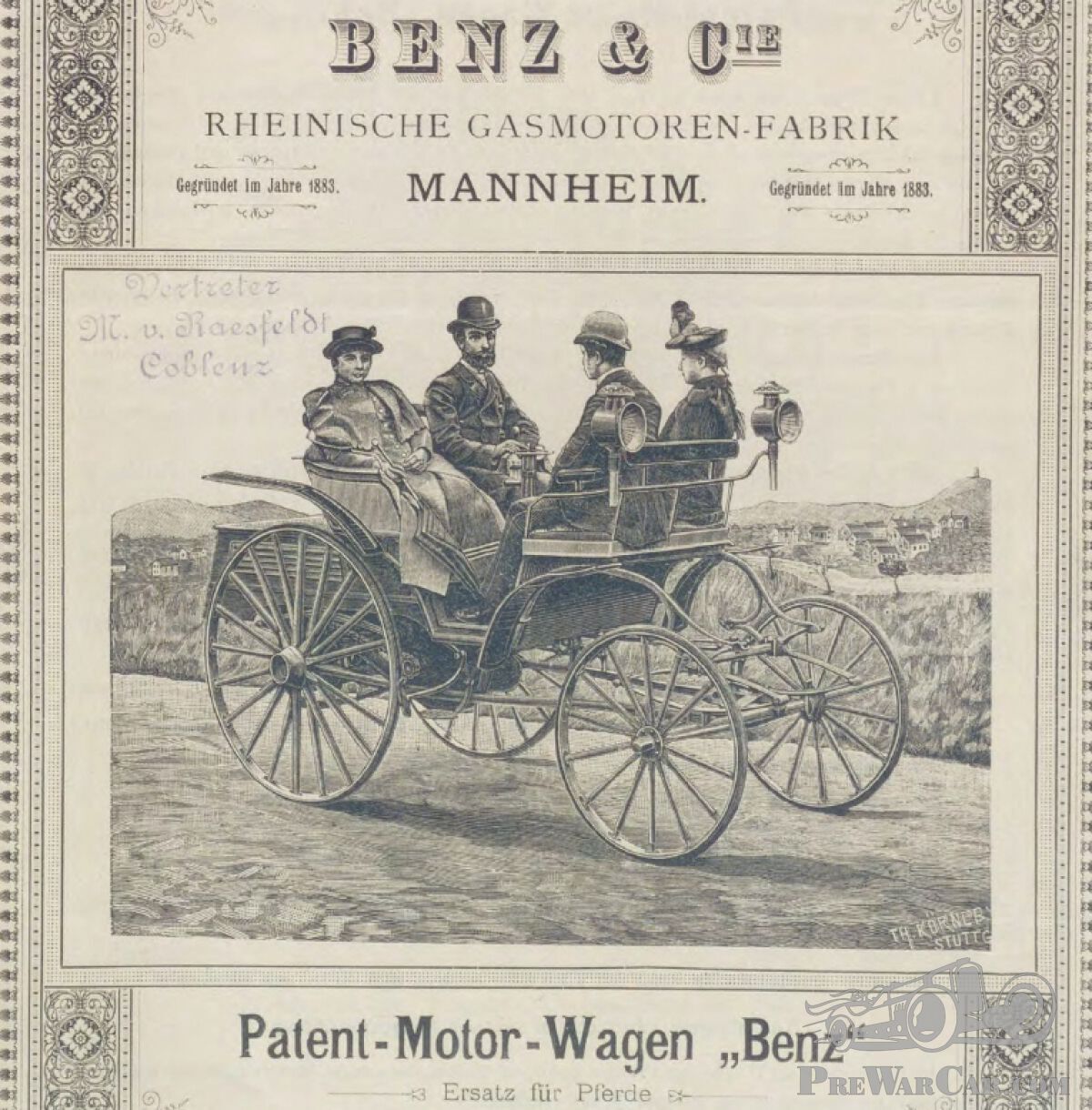
The catalogue also shows a four-wheeled Benz Viktoria similar to Zardetti's
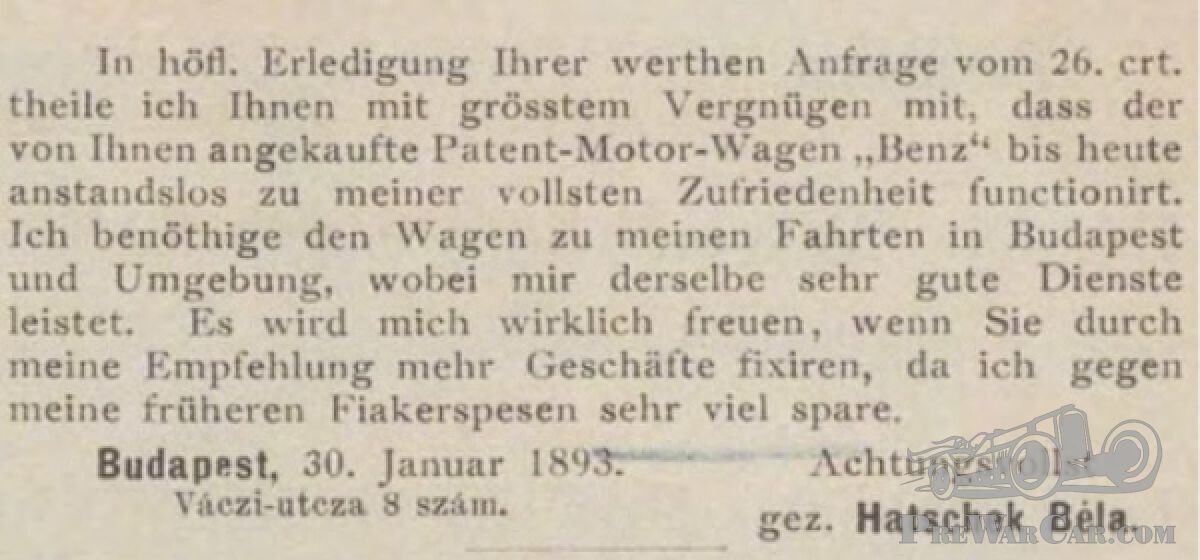
Hatschek's glowing review of his Benz as it appeared in the marketing catalogue


Nous ne savons pas exactement ce que nos lecteurs autrichiens et hongrois savent du passé automobile de leurs nations respectives, mais la plupart des gens ne savent pas grand-chose, si ce n'est que l'archiduc François-Ferdinand a été assassiné alors qu'il voyageait dans une Gräf & Stift. Nous en savons un peu plus, bien sûr, et nous pensons à Austro-Daimler et Lohner-Porsche, dont les origines nous ramènent en 1898.
Nous n'aurions pas pu vous dire quelle était la première voiture apparue en Autriche-Hongrie, mais il est tout à fait naturel que ce soit une Benz, et c'est ce qui s'est passé. Pendant de nombreuses années, les historiens ont accepté un article publié par l'Allgemeine Automobil Zeitung (journal automobile général) en 1911, intitulé "La plus ancienne automobile d'Autriche-Hongrie", qui concluait qu'il s'agissait d'une Benz achetée en mars 1893 par Eugen von Zardetti, un peintre suisse alors domicilié en Autriche.
Ce "fait" a été établi pendant 111 ans, jusqu'à ce que Christian Klösch, chercheur au musée des sciences et de la technologie de Vienne, tombe par hasard sur un document intéressant dans la bibliothèque l'année dernière. En parcourant une édition du Neuen Wiener Abendblatt (Nouveau journal du soir viennois) datée du 3 novembre 1892, il a découvert un passage sur "le premier voyage en automobile d'une voiture sans chevaux", nommant le pionnier de l'automobile Julius Jalowetz, un chimiste viennois qui avait fait tout le chemin jusqu'à Mannheim pour acheter sa voiture directement à Karl Benz. Lorsque Klösch a voulu en savoir plus, Mercedes-Benz lui a fourni une copie d'une brochure datant du début de l'année 1893, dans laquelle Jalowetz faisait l'éloge de la Benz Patent-Motor-Wagen.
La brochure contenait également une critique de Béla Hatschek, un opticien de Budapest qui deviendrait plus tard un fabricant de faux yeux (c’est à dire des yeuxen verre). La critique de Hatschek, datée du 30 janvier 1893, se lit comme suit : "C'est avec grand plaisir que je vous informe que la voiture à moteur breveté "Benz" que j'ai achetée fonctionne parfaitement et à mon entière satisfaction jusqu'à ce jour. J'ai besoin de cette voiture pour mes déplacements à Budapest et dans les environs, et elle me sert très bien. Je serais très heureux que vous fassiez d'autres affaires grâce à ma recommandation, car j'économise beaucoup sur les frais de fiacre que je payais auparavant".
Fort de cette nouvelle piste, Klösch approfondit ses recherches et finit par découvrir dans les archives de la ville de Budapest que Hatschek avait reçu un permis d'utilisation d'automobile le 26 novembre 189. D’ailleurs le nom de Hatschek n'est pas inconnu des historiens de l'automobile. En 1895, le Royal Automobile Club de Hongrie a publié dans son annuaire une photo de lui assis à bord de sa nouvelle Benz Velo en 1895.
Voilà une découverte majeure qui, nous espérons, contribuera à stimuler l'intérêt pour les premières voitures sans chevaux en Autriche et en Hongrie. Si vous vivez dans l'un de ces pays et que vous possédez une voiture de l'époque victorienne, pourquoi ne pas vous réunir avec d'autres passionnés et organiser une petite course pour commémorer les efforts des pionniers Jalowetz et Hatschek?
Paroles: Zack Stiling; photos: CE Auto Classic
Publié:
lundi mai 1st, 2023
Facebook
LinkedIn
Twitter
WhatsApp
Email
Copy
Commentaires
Robert Simons
12 Juin, 16:36
Horváth Ferenc
17 Mai 2023, 10:07
I am reporting from Hungary. Yes, we know the story of the optician Béla Hatschek with the first Budapest car.
There are almost no vehicles from the time of Kaiser Franz Josef I. in Hungary, even the museum examples were destroyed during the Second World War and the rest became victims of the politics of the 1950s.
Therefore we can't organize a road run to commemorate the pioneering efforts of Jalowetz and Hatschek. :o/
Lire la suite
There are almost no vehicles from the time of Kaiser Franz Josef I. in Hungary, even the museum examples were destroyed during the Second World War and the rest became victims of the politics of the 1950s.
Therefore we can't organize a road run to commemorate the pioneering efforts of Jalowetz and Hatschek. :o/
Michael Schlenger
01 Mai 2023, 09:12
It's a mystery to me why the author of this article doesn't mention the "Marcus-Wagen" from 1888/89 as "the first car ever to appear in Austria-Hungary". It had its flaws, wasn't particularly powerful and remained a prototype. Yet, it was without doubt an automobile with a four-stroke petrol engine and even the first one using a magneto-operated ignition. The best thing is: it still exists in running condition!
Lire la suite
Jeff Perkins
01 Mai 2023, 04:32
Great story… thank you Mr. Stiling for this and the other excellent articles you write!
Lire la suite
Lars Legaard
02 Mai 2023, 13:08
I totally agree, regarding Mr. Marcus. But as most old car people know, due to the fact that he had Jewish origins, the Nazis wanted the car being invented by Mr. Benz, and it is fantastic that the car could be kept hidden during WWll, but as far I know most of the Marcus archives were destroyed by orders from Himmler
The lesson is: You can never twist history!
Lire la suite
The lesson is: You can never twist history!
Michael Schlenger
03 Mai 2023, 00:18
I don't know or care what the National Socialists wanted some 80 years ago. I simply expect that a plain fact which is easily available today is taken into account, in particular if an author boasts that he knows "of course" more than the ordinary prewar enthusiast. I am pretty sure that the "Marcus car" is something the veteran car aficionados in Austria are pretty proud of - and rightfully so.
Lire la suite
Pal Negyesi
26 Août 2024, 08:58
The Marcus car is not part of this story and the reason for that is very simple. Both Dr Klösch who did the initial research and I, who did the research in Hungary, were focusing on imports. Yes, the Marcus vehicle was around—we are perfectly aware of this fact (Dr Klösch works at the Technisches Museum where the Marcus vehicle resides). The fact remains: Siegfried Marcus tinkered with his engine-powered device, but nothing came out of his experiments. Then in 1900 his prototype was dragged onto the "stage" and paraded as the first car built before Benz/Daimler in 1875. This enduring myth elevated the significance of his efforts. Just to explain further: Carl Benz did not invent the petrol-engined car, but he was the first to a) construct an automobile (not a motorized handcart, carriage or any other device but a well-thought out and patented transportation device) b) which became commercially successful. Siegfried Marcus and a lot of others before and after him (Hammel car anyone?) built motorised devices. So when we look at the first car in the Austro-Hungarian Monarchy we study whether Daimler, Benz, Peugeot, Panhard, etc. arrived first.
Lire la suite
I'd be fascinated to see more of the 1893 brochure which is mentioned. Is it available anywhere?