Le magazine et marché mondial pour les passionnés de voitures classiques, par des passionnés.
Le magazine et marché mondial pour les passionnés de voitures classiques, par des passionnés.


Filter
Faites votre choix:
- Voir les voitures
-
Marque >>
-
Année >>
-
-
Catégorie >>
- Voir les motos
- Voir les pièces et plus
-
Marque de la voiture >>
-
Constructeur >>
-
Catégorie >>
- Vélos
-
Année >>
-
Pays


Les dangers de la route: réflexions sur un accident précoce
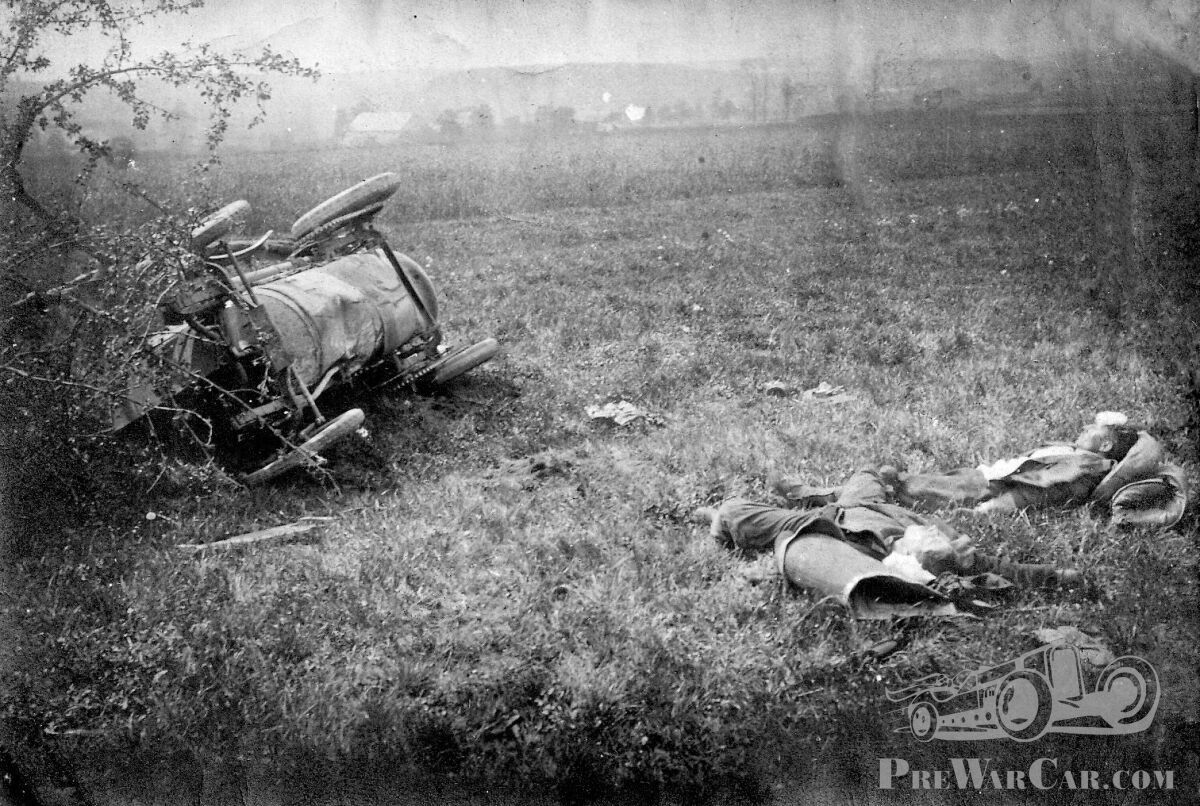

Les photographies apparaissent parfois dans les endroits les plus inattendus, et celle-là a certainement été une surprise lorsqu'elle a été déterrée par le lecteur Luc Ryckaert lors d'un carrousel de motos en Europe. Comme beaucoup de photographies des débuts de l'automobile, elle soulève de nombreuses questions.
Il est probablement inutile de demander ce que pourrait être cette voiture, car nous sommes certains qu'elle ne peut pas être identifiée, même par nos lecteurs les plus experts, mais nous serons ravis si quelqu'un peut nous prouver le contraire. Quant à la localisation, nous pensons qu'elle doit se situer quelque part en Europe, peut-être en France ou en Belgique. Une question plus pertinente serait: comment cet accident s'est-il produit? Qu'est-ce qui a provoqué cette terrible scène?
Il existe des dizaines de réponses plausibles à cette question. Les premiers temps de la circulation automobile étaient parsemés d'embûches, en particulier sur les routes accidentées et non aménagées des régions rurales. Les accidents pouvaient être causés par des nids-de- poule et d'autres défauts de la route, des nuages de poussière, des animaux sauvages ou des chiens errants, pour ne citer que quelques dangers courants. Il se peut que cet accident soit le résultat d'une défaillance mécanique, qui aurait pu découler d'une mésaventure antérieure.
Une collision avec un chien errant, par exemple, n'aurait peut-être pas été immédiatement catastrophique, mais si la direction de la voiture avait été endommagée, des problèmes auraient pu survenir plus tard. Mais il se peut aussi que l'accident ait été causé par un problème qui n'a certainement pas diminué avec le développement des voitures et des routes: l'erreur du conducteur, qu'il s'agisse d'inattention, d'excès d'enthousiasme ou d'une erreur d'estimation innocente.
Ce qui a été noté, c'est l'absence de foules s'occupant de la voiture ou de ses passagers, que ce soit pour les aider ou pour les regarder, bien qu'au moins l'un des occupants ait reçu un peu d'attention. Cela ne nous dit pas grand-chose, si ce n'est que l'accident ne s'est probablement pas produit lors d'une course, et qu'il a dû se produire à une distance raisonnable du village le plus proche pour ne pas attirer toutes les commères locales, pour qui une scène aussi morbide aurait pu fournir une bonne semaine de bavardages spéculatifs.
Nous pensons qu'un voyageur de passage, peut-être un fermier ou un ouvrier agricole, a eu connaissance de l'accident et a fait preuve de responsabilité en se rendant aussi vite que possible à la gendarmerie la plus proche. Un membre de la police locale a probablement pris la photo à des fins officielles et, 120 ans plus tard, elle s'est retrouvée dans un carrousel.
Paroles: Zack Stiling; photo: Luc Ryckaert
Publié:
mardi avril 23rd, 2024
Facebook
LinkedIn
Twitter
WhatsApp
Email
Copy
Commentaires
David Grimstead
29 Avril 2024, 16:31
Michel Pilette
03 Mai 2024, 17:46
Correct. The accident occurred on the return journey of my grandfather to Belgium after maintenance of the car in Germany. Thanks for the additional information, of which I was not aware.
Kind regards,
Michel Pilette
Lire la suite
Kind regards,
Michel Pilette
Luc Ryckaert
25 Avril 2024, 09:27
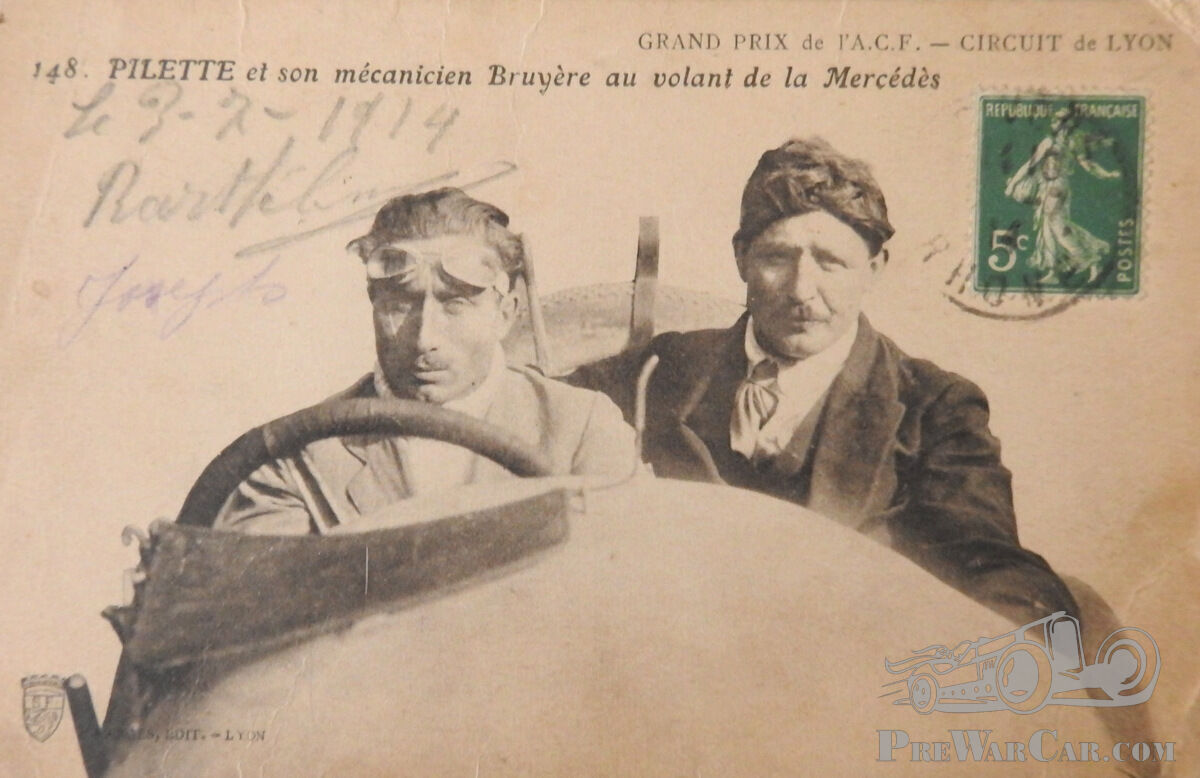
Thanks to Nick Jonckheere (The Automobile contributor), I know what happened before this sad photograph was taken. Théodore Eugène Pilette was a Belgian racing driver, that started racing in 1913 and was the first Belgian to race at the Indianapolis 500. Located in Brussels, he was the Belgian importer for Bugatti and Mercedes. In 1921, his Mercedes was entered for a race at Brooklands, that took place on May 15th. The week before, he and his mechanic Bruyère drove the car to Stuttgart, to have the final preparations done at the factory. The journey back started on Thursday, and on Friday 13th they arrived in Luxembourg, where it all went wrong around 10.00 a.m. Near Steinfort, the Mercedes left the road and hit a tree. The driver and passenger were thrown out of their car and later found unconscious. They never regained consciousness and died on the way to the hospital . Nevertheless, the passion for car racing remained in the Pilette family. Théodore was the father of auto racer André Pilette and grandfather of racer Teddy Pilette. Enclosed a picture of Pilette and his mechanic Bruyère taken at the Grand Prix de l'A.C.F., circuit de Lyon 1914.
Lire la suite
Michel Pilette
03 Mai 2024, 17:54
Thank you for the useful information. My grandfather's full name was Théodore Jean Henri Pilette, not Eugène. He started racing at the turn of the century, starting with a De Dion tricycle.
Lire la suite
Graham Edwards
24 Avril 2024, 08:15
Perhaps a ’staged’ photograph? I hope so! It appears well composed. Does look like a Mercedes radiator. Some kind of motorsport ’health and safety’ campaign shot??
Lire la suite
Michel Pilette
03 Mai 2024, 17:56
This is the copy of the original picture of the death of my grandfather.
Lire la suite


Stuart Griffin
23 Avril 2024, 21:48
Hi. A really interesting photo. I am concerned the two men I see in the photo are not in the best of health, and in fact may have departed this mortal coil, of their presumed injuries.
The bottom of the rolled car looks rather like the bottom of the 1908 Mercedes racer, in the Models of Yesteryear range, I played with as a child—possibly played with a little too much bearing in mind the time it spent upside down. Chain-drive with mighty drive sprockets, hefty and large diameter wheels and the underbody fairings throughout. It also featured a massive Left Hand external exhaust system and was right-hand drive.
Its has to be sobering to realise the carnage the early motorists endured, with awful roads, frequent punctures and mechanical reliability, brakes which were marginal at best and really no human protection.
No seat belts even, and yet it took a long time to realise being thrown from a couple of tons of high speed steel could rarely have a good outcome. Most sobering is to realise too many folk still seem to thing the most basic of safety measures don't really need to apply to them.
I am intrigued to know more of the true story, and hope my interpretation is complete nonsense, and the passengers are merely resting after a truly lucky escape,
Regards,
Stuart
Lire la suite
The bottom of the rolled car looks rather like the bottom of the 1908 Mercedes racer, in the Models of Yesteryear range, I played with as a child—possibly played with a little too much bearing in mind the time it spent upside down. Chain-drive with mighty drive sprockets, hefty and large diameter wheels and the underbody fairings throughout. It also featured a massive Left Hand external exhaust system and was right-hand drive.
Its has to be sobering to realise the carnage the early motorists endured, with awful roads, frequent punctures and mechanical reliability, brakes which were marginal at best and really no human protection.
No seat belts even, and yet it took a long time to realise being thrown from a couple of tons of high speed steel could rarely have a good outcome. Most sobering is to realise too many folk still seem to thing the most basic of safety measures don't really need to apply to them.
I am intrigued to know more of the true story, and hope my interpretation is complete nonsense, and the passengers are merely resting after a truly lucky escape,
Regards,
Stuart
Ben Collings
23 Avril 2024, 15:51
Looking at the picture I think it might be a Mercedes racing car from 1910/12 due to the distinctive front and rear axles, the narrow section chain with large sprockets, the outside exhaust collector tube and cable rear brakes.
It also appears to have a large vee-fronted radiator supported by a cross tube that drops down in the centre. I think it has wooden wheels (both of these things rule out the 1913 factory racers) as well as having a rear-mounted spare tyre. Maybe they were out road testing due to the front axle-mounted number plate?
Lire la suite
It also appears to have a large vee-fronted radiator supported by a cross tube that drops down in the centre. I think it has wooden wheels (both of these things rule out the 1913 factory racers) as well as having a rear-mounted spare tyre. Maybe they were out road testing due to the front axle-mounted number plate?
Richard Smith
23 Avril 2024, 22:36
The starting handle remains in place the shape of which might help with identification.
Lire la suite
Steve Diggins
23 Avril 2024, 09:12
It looks like the three people laying in the grass are alive and waiting for a medic.
Lire la suite
Tony Press
24 Avril 2024, 04:06
I can only see two unfortunates and both look to be rather in trouble :-(
Lire la suite
Luc Ryckaert
23 Avril 2024, 09:00
In the meantime, thanks to Nick Jonckheere, I know the true facts of this photo. I will send my comment later, but first I'm too curious to see what the other PreWarCar readers think...
Lire la suite
Richard Smith
23 Avril 2024, 08:35
The car has chain drive, a full under tray, no wings and a side mounted exhaust pipe which suggests a racing car. Also notable for a smash-up of the day is that all four wheels appear to have survived the experience relatively intact.
Lire la suite
“The day before the race Pilette, driving a Grégoire racer around the circuit for the last time before the contest, took a corner too fast at Longlier and crashed with terrific force against the roadside, which was made of rock. The automobile was broken to pieces and Pilette had his right arm crushed. His goggles were shattered into a thousand fragments and pieces of glass entered his eyes and forehead. His physician takes a hopeful view of his condition.”
Recovered from these injuries he competed there again in 1907 in a Vivinus (Liederkerke Cup) and a Mercedes (Circuit des Ardennes). From then he was a successful car agent and amateur racer for the latter until—déjà vu—May, 1921. Then, driving perhaps a version of the 9.2-litre 90 h.p. Type G-4F four-cylinder aero-engined and chain-drive G.P. Mercedes that he had driven to third place at Le Mans in 1913 and with little time left on the 13th of the month to get to Brooklands, he crashed near Steinfort/Capellen just 30 miles south-east of Longlier on the route back from Luxembourg to Brussels.
He and Bruyère died in futile preparation for a four-car wager race scheduled to run at the end of the May 16th, 1921, the Brooklands Whitsun Bank Holiday Monday meeting; to the winner, it was worth 80 guineas (approx. £5,153 today). It was unlikely that Pilette knew it had already been cancelled after Capt. John Hartshorne Cooper died crashing his Clerget-engined Mercedes in testing there on Thursday, May 12th, nor that Philip Rampon’s Martin-Arab (11.8-litre Sunbeam) had failed scrutineering, leaving just Count Zborowski’s Chitty-Bang-Bang. There was much reporting in Britain about Cooper’s demise but not Pilette’s, and much about the danger of hybrid aero-engined racers.