Le magazine et marché mondial pour les passionnés de voitures classiques, par des passionnés.
Le magazine et marché mondial pour les passionnés de voitures classiques, par des passionnés.


Filter
Faites votre choix:
- Voir les voitures
-
Marque >>
-
Année >>
-
-
Catégorie >>
- Voir les motos
- Voir les pièces et plus
-
Marque de la voiture >>
-
Constructeur >>
-
Catégorie >>
- Vélos
-
Année >>
-
Pays


‘Mystery car’ on the platform of the Lynton and Lynmouth Cliff Railway c.1905
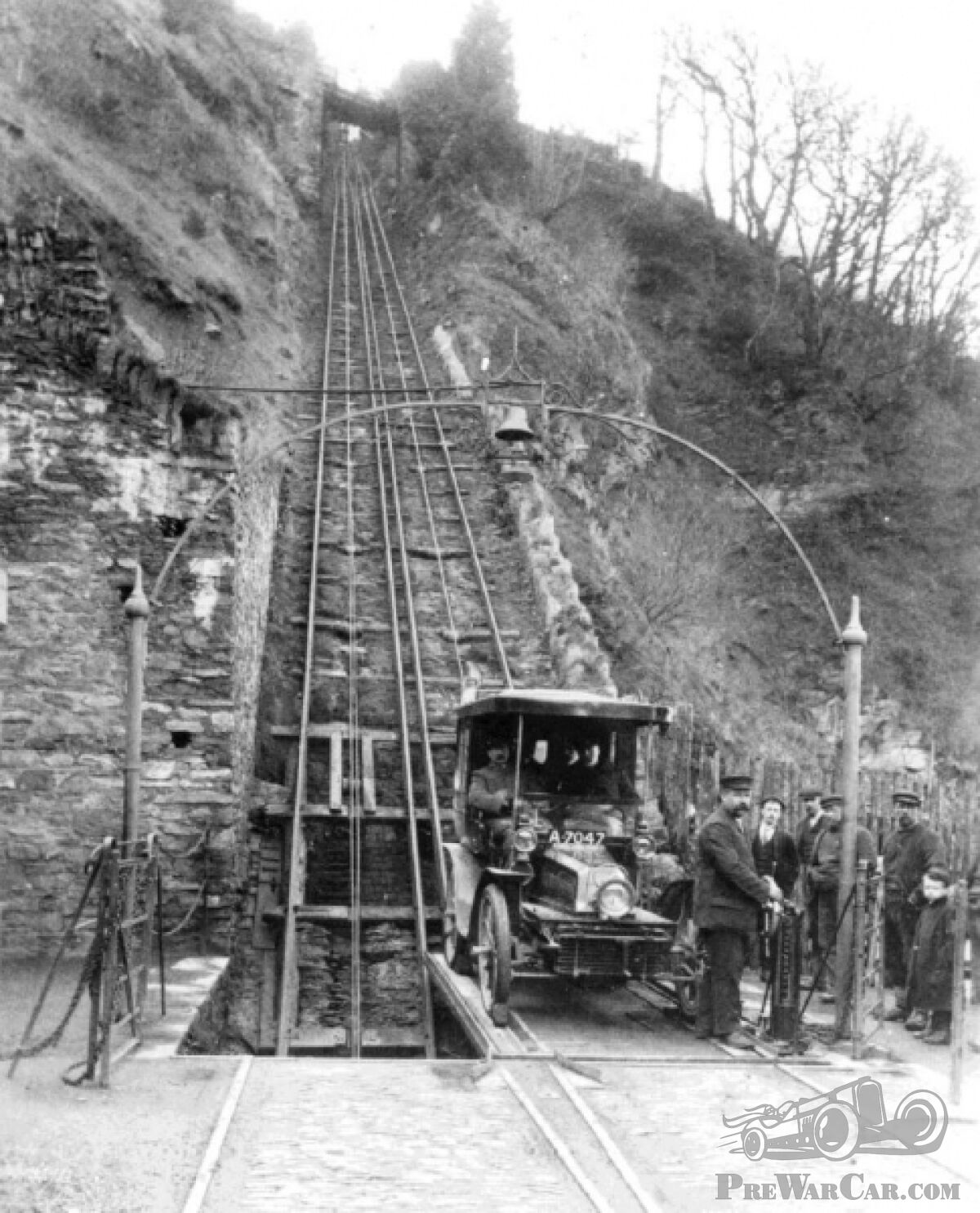

Recreating a photograph from 1905 can be a lot of fun. It all starts with getting the right car. But what to do when you don't know what car it is in the photograph? Rob Shaddick, director of the Lynton & Lynmouth Cliff Railway did the right thing. He asked around, and found us to help him with this mystery car. First, we thought a De Dion-Bouton or a Renault, but some specialists don't think this is correct.
What we know: the car, registered A 7047, was owned (we assume) by Sir George Newnes (who is sitting in the car next to his driver). Sir George Newnes was a key financier of the Cliff Railway.
The Cliff Railway was originally used to take cars between the two villages as Lynmouth Hill was only a dirt track. This made it impossible for cars to get up the steep hill with their less powerful engines. But this came to an end as cars became able to cope with the incline. In 1952, the lift was used again to move cars during the Lynmouth flood disaster. The Cliff Railway was established in 1888 and has been in permanent use since its opening in 1890.
So, the railway will stay, but what about this mystery?
Publié:
lundi décembre 11th, 2017
Facebook
LinkedIn
Twitter
WhatsApp
Email
Copy
Commentaires
Rob Shaddick
14 Décembre 2017, 11:19
if you email me at [email protected] then I can email you back a higher res image for you to take a look at it if helps.
Lire la suite
Ariejan Bos
13 Décembre 2017, 23:46
The shape of the rear mudguard is not a very useful id feature, because it is not an integral part of the chassis. I can show you identical Georges Richard models having either a curved or a horizontal end tip of the rear mudguard. I still think Georges Richard is the most likely option.
Lire la suite
Tim Moore
13 Décembre 2017, 16:44
I'm not sure the shape of the wings is too important, as different coach-builders were used. Company Française de Materiel de Chemins de Fer in Ivry Port, just up the road from the Richard Brasier factory was one. I suggest a 1903 Richard-Brasier, either the 4-cylinder 24hp, or slightly less likely a 2-cylinder, 12hp model H, both were shaft driven. As mentioned the photo quality is not quite good enough, but the radiator is definitely correct and if there are two inspection flaps on top of the bonnet (which I think there might be) it's the 24hp, and if there is one, it's the 12hp
Lire la suite
Rob Shaddick
13 Décembre 2017, 08:11
Thank you for your comments on this and trying to solve the mystery for us.. on looking at the suggestion of the 1903 Georges Richards I am not convinced as the rear mudguards look horizontal in the original photo and they curve over the back wheels on a Georges Richards - the shape of the mudguards is more similar to a Mors.. but then the crank handle is off-set to the wrong side?
Lire la suite
Ariejan Bos
12 Décembre 2017, 17:21
Despite the fact that the photo lacks detail, enough can be seen to narrow the choices down to two makes: Georges Richard and Mors. Both had around 1902 models like this with a similar type of bonnet, a large cooling package between the spring horns, a transverse rod connecting these spring horns and an asymmatrically placed crank handle. Although not all Mors models had chain drive at the time, most had, whereas most Georges Richard's didn't. And although I can't rule it out completely, this car doesn't seem to have chain drive. This observation as well as comparison with other images makes me conclude that the car is a ca 1903 Georges Richard. The make was imported by Mann & Overton in London.
Lire la suite
Rick Ford
12 Décembre 2017, 10:49
Lynton/Lynmouth cliff railway often erroneously referred to as “funicular”, was indeed financed by Newnes but more surprisingly built by local builder, Jones. The carriages had no motive power merely a large water tank below the passenger compartment, and a long cable ran the lengths of the up and down tracks and around higher and lower pulley wheels. Early on a summers day happy visitors from the many lodging houses and hotels, high up in Lynton would seek the beaches and other attractions down at seaside Lynmouth. So the higher carriage would be soon filled with people whilst the lower would be near empty! Arecipe for disaster? No just fill the lower unit’s tank with the plentiful water until the weights nearly balance and the carriages progress in stately silence interrupted only by the squeals of delight from the younger passengers descending. Full story at http://www.cliffrailwaylynton.co.uk/
As in many branches of engineering, simplicity often triumphs! The car? I’ll leave that to more knowledgeable readers.
Lire la suite
As in many branches of engineering, simplicity often triumphs! The car? I’ll leave that to more knowledgeable readers.
Kevin Atkinson
12 Décembre 2017, 09:37
Sir John Newnes was a very important figure in early motoring in that he was instrumental in supporting and effectively buying out Darracq.
If I remember right an English consortium had an option on Darracq production but ran out of money. Newnes stepped in and bought them out of the option. I believe this was a key reason why Darracq did not disappear in around 1904.
I really must go back and reacquaint myself with the facts on this one!
Lire la suite
If I remember right an English consortium had an option on Darracq production but ran out of money. Newnes stepped in and bought them out of the option. I believe this was a key reason why Darracq did not disappear in around 1904.
I really must go back and reacquaint myself with the facts on this one!
Greg Mackie
12 Décembre 2017, 04:28
The town of Newnes in NSW, Australia, was named after Sir George Newnes.
A shale mine operated there for many years, and a railway ran over difficult terrain. The 'All-Wheel-Drive' Shae locomotives were used very successfully there.
Lire la suite
A shale mine operated there for many years, and a railway ran over difficult terrain. The 'All-Wheel-Drive' Shae locomotives were used very successfully there.