Le magazine et marché mondial pour les passionnés de voitures classiques, par des passionnés.
Le magazine et marché mondial pour les passionnés de voitures classiques, par des passionnés.


Filter
Faites votre choix:
- Voir les voitures
-
Marque >>
-
Année >>
-
-
Catégorie >>
- Voir les motos
- Voir les pièces et plus
-
Marque de la voiture >>
-
Constructeur >>
-
Catégorie >>
- Vélos
-
Année >>
-
Pays


Un break sportif: découvrez le mystère du roadster de Leipzig
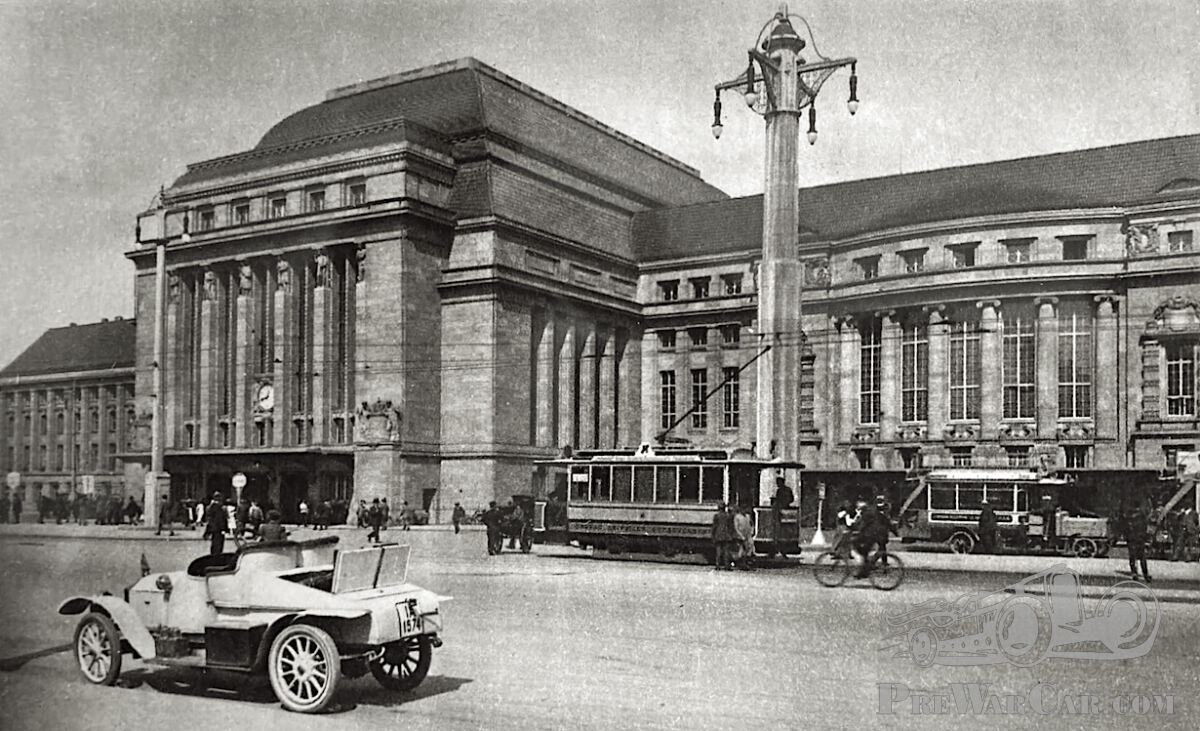

Voilà le Hauptbahnhof de Leipzig, la gare principale ferroviaire de la ville, dans toute sa splendeur. La photo remonte probablement aux premiers jours de la gare. Les locaux d’environ 84 000 mètres carrés ont ouvert leurs portes en 1915 avec trois vastes étages, permettant d'accueillir bien plus que les voies ferrées et les quais. Notez également le lampadaire colossal.
Nous ne sommes pas là pour vous parler de l'architecture, ni des boutiques et des restaurants que l'on peut encore trouver à l'intérieur. Nous sommes peut-être intéressés par les trains à vapeur, mais ce n'est pas non plus notre but d'écrire à son sujet. Il n'y a pas de train en vue de toute façon, mais nous voyons une variété de moyens de transport: un tramway, un omnibus, un vélo et, très en vue, une voiture. Ce que nous aimerions savoir, c'est ce qu'est cette belle voiture. La plaque d'immatriculation IA 1574 indique qu'il a été immatriculé à Berlin, à environ 200 kilomètres au nord de Leipzig. Le siège en forme d'épingle suggère qu'il était utilisé pour transporter plus d'une personne à la gare. Au moins, le stationnement n'était pas un si grand problème!
Après la Seconde Guerre mondiale, la gare, lourdement bombardée, a dû se passer de toit pendant les dix années suivantes, mais ensuite le bâtiment a été restauré pour retrouver sa gloire d'antan. Renseignez-vous si vous le souhaitez. Il semblerait que l'on puisse encore faire une image similaire aujourd'hui.
Paroles: Jeroen Booij, Photo: source inconnue
Publié:
jeudi juillet 25th, 2024
Facebook
LinkedIn
Twitter
WhatsApp
Email
Copy
Commentaires
Hergen Deuter
01 Août 2024, 14:31
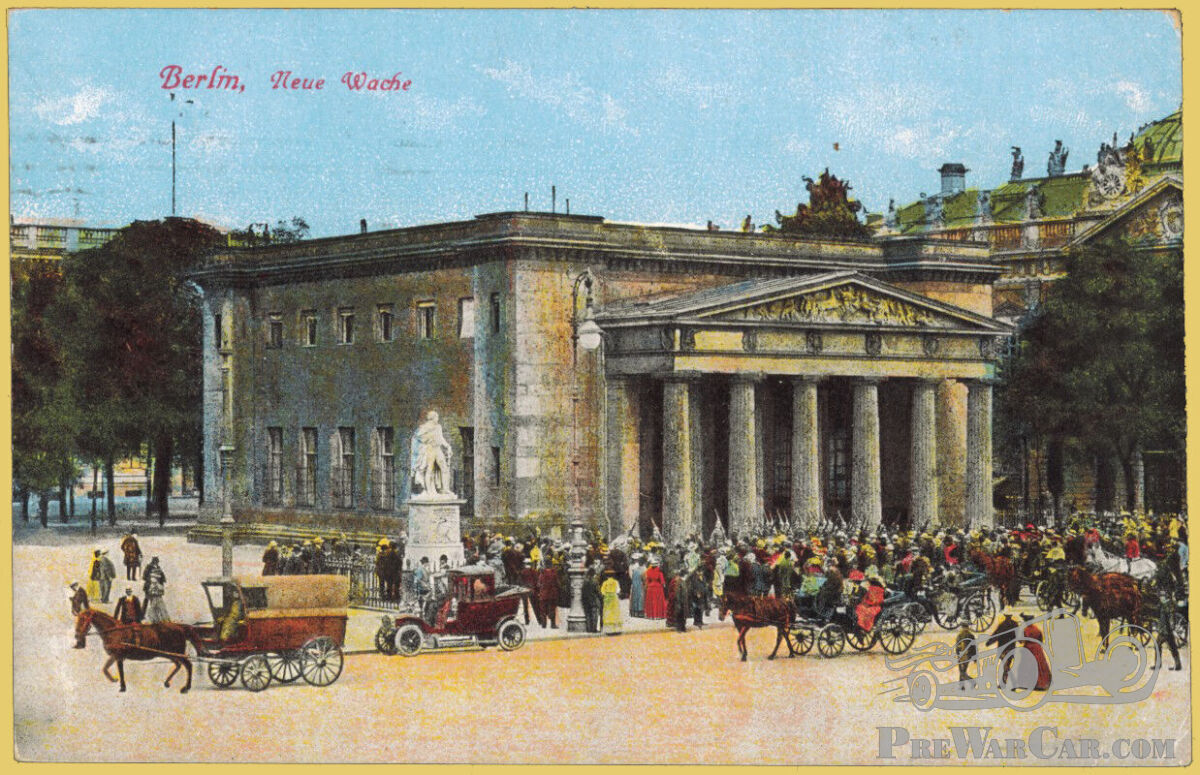
Here we see a contemporary postcard from the Neue Wache in Berlin, which in turn might lead us to ask what kind of car is depicted on it.
Lire la suite
Dieckmann Hans
26 Juillet 2024, 12:28
The vehicle owner was (Adolf?) Böcklin von Böcklinsau of Berlin, Unter den Linden 4/5.
--------------------------------------------------------------------
Fahrzeugeigentümer war (Adolf ?) Böcklin von Böcklinsau, Berlin, Unter den Linden 4/5.
Lire la suite
--------------------------------------------------------------------
Fahrzeugeigentümer war (Adolf ?) Böcklin von Böcklinsau, Berlin, Unter den Linden 4/5.
Hergen Deuter
31 Juillet 2024, 21:19
In Berlin's boulevard Unter den Linden 4 there was no residential building even around 1915, but the Neoclassical Neue Wache, built by Karl Friedrich Schinkel in 1818, was in those days used as the headquarters of the military command and is a memorial now. Adolf Böcklin von Böcklinsau was a lieutenant general, but probably should have been retired then, as he must have been already 77 years old.
Lire la suite
Fredy Ley
29 Mai 2024, 11:45
Now that we have dealt with the rear dumb-irons, which were a copy of those used on horse-drawn vehicles, as well as right-handed knights (forget left-handed ones), I invite you to take a ride on the omnibus parked in front of the station. The Leipziger Allgemein Kraftomnibus A-G was equipped with Daimler, Dürkopp, and Büssing omnibuses. The photo shows a Büssing double-deck type Leipzig 35 PS omnibus from 1913.
Lire la suite
Ivo Braeken
28 Mai 2024, 16:51
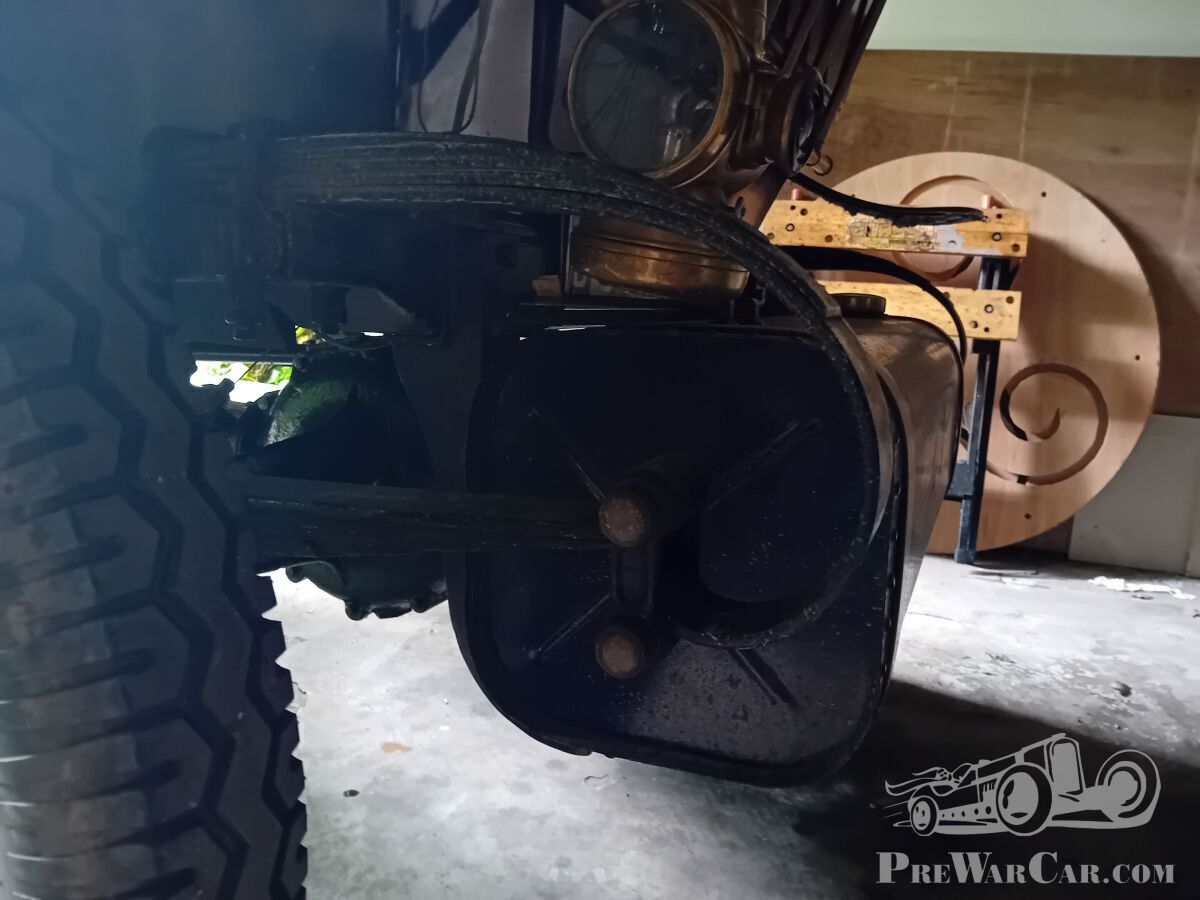
Another feature of Métallurgique is the lack of cooling fins in the bonnet and the wind tunnel under the car to suck warm air out. I include a photo of the dumb iron of a Métallurgique. I think it is a match.
Lire la suite
Ariejan Bos
30 Mai 2024, 09:36
The spring system you show is the normal spring configuration of a Métallurgique during that period. The official name was "three-quarter elliptic spring with swan neck" (because of the downward curve at the end; in French: ressort demi-pincette à crosse). In rare cases you can observe half-elliptical springs with a transverse spring (e.g. in the case of the well-known 1911 Vanden Plas speedster in the Auburn-Cord-Duesenberg Museum in the US). The spring system on the Leipzig car has an outward curved dumb-iron, supporting the end of a half elliptic spring. For example Peugeot was a regular user of this system in these years, but I've never seen that on a Métallurgique.
Lire la suite
Keith Kuehn
25 Mai 2024, 20:31
Okay, Ivo, you started this! It's a good question actually, as I bet a lot of folks that visit this website question a lot of early information and names. Now, I wonder how those parts got the name "dumb irons"!
I get asked a lot, "Why right hand drive?" I've always thought that was because ships had "port" and "starboard" or "Steering board", which is the right-hand side of the ship. Another reason I've heard is that is the side the coachman controlled the horses from... either explanation being good, of course.
Lire la suite
I get asked a lot, "Why right hand drive?" I've always thought that was because ships had "port" and "starboard" or "Steering board", which is the right-hand side of the ship. Another reason I've heard is that is the side the coachman controlled the horses from... either explanation being good, of course.
Christoph Röhrs
26 Mai 2024, 21:49
Why right-hand drive? Another explanation for driving on the left-hand side of the road is that in earlier times knights also rode on the left-hand side, because then they had their right hand free for the sword towards the centre of the road in case of defence.
Lire la suite
Keith Kuehn
24 Mai 2024, 20:01
Yes, Ariejan. Those dumb irons appear the same as my 1910 Alldays, and so does the radiator shape. I'm positive it is NOT an Alldays and Onions, though!
The motor car in the photo does appear to be a very sporty little fella though!
Lire la suite
The motor car in the photo does appear to be a very sporty little fella though!

Fredy Ley
24 Mai 2024, 10:44
Going by the bonnet, I think this beautiful car is a Bergmann-Métallurgique "Victoria Coupé" 8/16hp with 1910 Van den Plas bodywork.
Lire la suite
Ariejan Bos
24 Mai 2024, 13:41
I agree, though I have a bit of a problem finding a Métallurgique with similar rear dumb-irons.
Lire la suite
Ariejan Bos
25 Mai 2024, 17:36
In French: main de ressort. In Dutch: veerhand.
Lire la suite
Ariejan Bos
25 Mai 2024, 17:33
That is the cast-iron bracket holding the spring.
Lire la suite