Le magazine et marché mondial pour les passionnés de voitures classiques, par des passionnés.
Le magazine et marché mondial pour les passionnés de voitures classiques, par des passionnés.


Faites votre choix:
- Voir les voitures
-
Marque >>
-
Année >>
-
-
Catégorie >>



1938 BSA Scout Series 6C Four-Seater Sports Tourer | Brightwells | Auction Ends: Wed 16th Sept
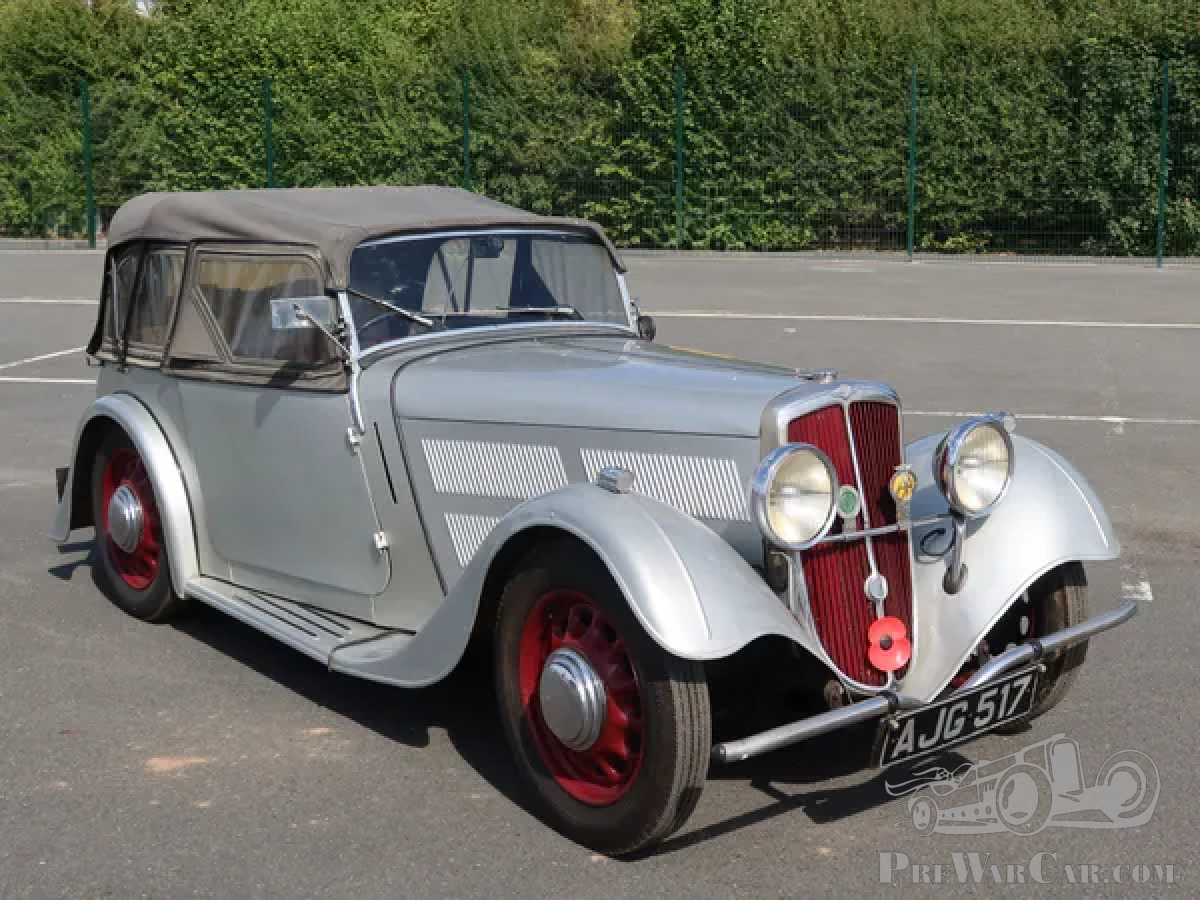

1938 BSA Scout Series 6C Four-Seater Sports Tourer | Brightwells | Auction Ends: Wed 16th Sept
Extremely rare Series 6C four-seater, one of only 10 surviving; large and interesting history file; well maintained and in regular use; a charming example of this quirky front-wheel drive sportscar
Although BSA had built their first car in 1907, they were much better known for their core business of motorcycle production. They enjoyed some success with a range of quirky three-wheelers which stole sales from Morgan in the early 1930s but the car that really put BSA on the radar for the sporting driver was the Scout.
Described by Autocar as ‘undoubtedly one of the best-looking small cars in existence’, the Scout had front-wheel drive and a low centre of gravity which gave it remarkably stable handling compared to rivals like the Riley Nine and the MG Midget.
Produced in six series from 1935 – 1939, the Scout was available as a two- or four-seater open sports model or a closed two-seater coupe. Initially powered by a Hotchkiss-designed 9hp 1,075cc V-twin engine, this was replaced by a 10hp 1,203cc unit by the time the Series 3 came out in 1936.
With a Renault-style push/pull 3-speed gearbox and effective four-wheel brakes, it was considerably cheaper than the MG T-Series Midget but with comparable 70mph performance and with the bonus of more advanced independent front suspension. It also had a far more spacious cabin than its notoriously cramped rivals thanks to a dash-mounted gearchange and no central transmission tunnel to eat up precious leg-room.
According to Graham Skillen's history of the model, only 3,003 Scouts were made in total, of which 498 were Series 6 variants, just 132 of them Series 6C four-seaters which were built on a longer chassis than the two-seater A or B variants. Known Series 6 survivors numbered just 44 in 2016, current club records indicating that there are now only five of the 6C four-seaters left in the UK, with a similar number overseas, although the state of them is not recorded.
First registered in Canterbury in December 1938, this BSA Scout is one of those few remaining Series 6C models and incorporates various upgrades over its predecessors, including more powerful 12v electrics, Bendix cable brakes and Easy-clean pressed steel wheels rather than wire wheels. The engine was also improved with increased water-jacketing, three-bearing crankshaft, more effective lubrication, larger valves and a downdraught carburettor.
Little is known of the car’s early history but a buff logbook shows that by 1959 it was owned by Medway Auto Sales of Chatham, moving to Durham in 1962. From 1978 – 1991 it was owned by a Mr J Calver of Durham, a leading member of the BSA FWD Owner’s Club who reputedly renovated the car during his ownership.
From 1991 – 2008 it was owned by a Mr P Pecherski of Ripley and from 2008 – 2014 by a Colonel Mark Cuthbert-Brown of Shrewsbury who took it with him to Germany and used it as a runabout while he was stationed with the BAOR in Osnabruck.
There are a good file of invoices from 2008 onwards to show regular upkeep, including what looks to be a fairly major engine and cylinder head overhaul in 2012 with a new timing chain, core plugs, gaskets etc.
Other stand-out items include a new galvanised petrol tank in 2014; new Solex carb in 2013; new starter motor in 2012; new radiator core and new wiring loom plus many other new electrical components in 2010; new brake linings and shocks rebuilt plus a new electric water pump to supplement the thermosyphon cooling in 2008.
A fellow Army officer and BSA FWD Club member, our vendor acquired the car from the Colonel in December 2014 and has continued to look after it well, including a new battery and an overhaul of the starter motor in 2020 and a new SU fuel pump earlier this year. A battery isolator switch is also hidden beneath the dash and flashing indicators have been discreetly incorporated into the sidelights.
Always in light regular use, nine old MOTs show the mileage rising from 82,395 in April 1995 to 89,369 in July 2012 when it passed with advisories recorded. Now MOT-exempt, our vendor has added another 300 miles or so during his 12-year ownership, the odometer currently showing 89,673 miles.
Aside from all the invoices and ownership records, there are also various historic photos of the car, sundry useful spares plus a wealth of technical literature relating to the model – original handbook, parts catalogue and lubrication chart; period road tests; restoration manuals; over 200 club magazines; books on BSA cars; technical bulletins from the club etc, a fraction of which is shown in the photos here.
Indeed a photo of this very Scout appears on page 66 of the book celebrating 50 years of the Daimler & Lanchester Owner's Club, BSA having taken over both these illustrious marques in 1910, finally selling Daimler to Jaguar in 1960. The icing on the cake is the original Kent-issue mumber plate, AJG 517, which is transferable and doubtless has a value of its own.
To assist in keeping the car in tip-top running order there is a very active BSA Front Wheel Drive Owner's club which holds extensive stocks of spares, new and used. They also publish a monthly magazine and stage many events and rallies, not to mention monthly online virtual meetings, so the social side is well covered too.
As you can see in the photos, this charming and well-historied Scout appears to be in great shape for an 88-year-old and has been starting promptly and running well as we have moved it around on site, with healthy 40psi oil pressure.
In over 20 years of hosting these sales, this is only the third Scout we have ever offered so you are unlikely to see another for sale any time soon, let alone one as smart as this rare Series 6C.
Consigned by James Dennison – 07970 309907 – [email protected]
Plus d'annonces dans cette vente
 1936 Morris 8 Tourer | Brightwells | Auction Ends: Wed 16th Sept
 1936 Morris 12 | Brightwells | Auction Ends: Wed 16th Sept
 1930 Ford Model A Pick-Up | Brightwells | Auction Ends: Wed 16th Sept
 1925 Donnet-Zedel G2 Saloon | Brightwells | Auction Ends: Wed 16th Sept
Plus d’annonces de ce revendeur professionnel
 1914 Humber Tourer
 1934 Austin 10/4 Colwyn Cabriolet | Brightwells | Auction Ends: Wed 16th Sept
Annonces similaires BSA Scout Series 6C Four-Seater Sports Tourer 1938 a vendre
 BMW 319 - 1935 Cabrio/Sport
 Chevrolet 2D Business Coupé 1936*
 1938 Delahaye 135M Figoni & Falaschi Cabriolet
 1934 Aston Martin Mk II (short chassis)
Utilisateur:
Date:
12-09-2026
Location:
Leominster, Herefordshire, Royaume-Uni
Partager:
Facebook
LinkedIn
Twitter
WhatsApp
Email
Copy



- AC
- Albert
- Albion
- Alldays
- Alta
- Alvis
- Arab
- Ariel
- Armstrong Siddeley
- Arrol-Johnston
- Aston Martin
- Atalanta
- Austin
- Autovia
- BSA
- Bat
- Bean
- Beardmore
- Bedford
- Beeston
- Belsize
- Bentley
- Beverley Barnes
- British Salmson
- Briton
- Brough Superior
- Calcott
- Calthorpe
- Century
- Chater Lea
- Clyno
- Coventry-Premier
- Crossley
- Cubitt
- Dennis
- ERA
- English Mechanic
- Frazer Nash
- G.W.K.
- GN
- Gwynne
- H.E.
- H.R.G.
- Hillman
- Humber
- Imperial
- International
- Invicta
- Jackson
- Jaguar SS
- Jensen
- Jowett
- Lagonda
- Lanchester
- Lea Francis
- Leyland
- MG
- Marendaz
- Maudslay
- Maxim
- Morgan
- Morris
- Napier
- New Carden
- Phoenix
- Premier
- Railton
- Raleigh
- Raymond Mays
- Riley
- Rolls-Royce
- Rover
- Santler
- Siddeley
- Singer
- Standard
- Star
- Straker-Squire
- Sunbeam
- Surrey
- Swift
- Talbot
- Thornycroft
- Triumph
- Trojan
- Vauxhall
- Victor
- Vulcan
- Waverley
- Wolseley (-Siddeley)
Autre(s) Britanique Voitures à vendre
Voiture BSA Scout Series 6C Four-Seater Sports Tourer 1938 a vendre
Contacter Utilisateur